TCL99 Withdrawal: Payout Times, Limits and Verification
A casino only shows you what kind of counterparty it is at the cashier, which is why the payout process is where this page spends almost all of its attention. Read enough Australian player reports about TCL99 and one pattern separates the slow experiences from the fast ones, and it has almost nothing to do with the payment method and almost everything to do with paperwork. A first request can sit for days while compliance works through a photo of a driver’s licence, while requests made on an account that is already verified routinely clear inside the hour on the same rails. TCL99 does carry public complaints about slow payouts, and when you read them closely, most describe a first withdrawal rather than a tenth. This page sets out what the payout process actually involves, which four things hold it up, and what to do on each day that passes with your money still sitting in the casino.
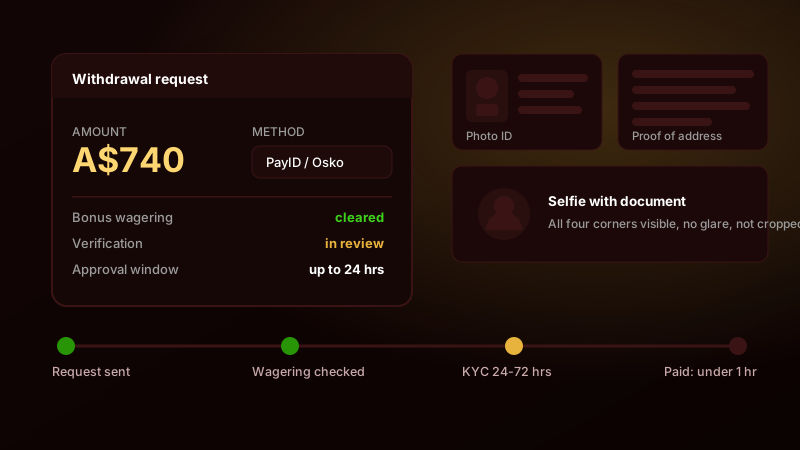
How a TCL99 payout actually works, start to finish
A TCL99 withdrawal runs in two stages, and confusing them is the reason a lot of players think they have been ignored when they have not. Stage one is approval: a human, or a rules engine with a human behind it, looks at your account and decides whether the request is legitimate. Stage two is settlement: the money leaves the casino and travels down whichever rail you chose. Speed lives entirely in that second stage. PayID clearing in forty minutes means nothing if the request spent twenty-two hours waiting for a compliance tick first, and that is exactly what the chart further down is built to show.
The order of operations inside your account matters as much as the method you pick. Bonus balance and cash balance are held separately, and the cashier reads both before it lets a request through. Verification is a one-off gate that everybody passes eventually but that only causes pain when you leave it until the moment you want your winnings. The deposit method you used quietly decides which payout rails are even available to you, because the operator applies a source-of-funds rule: money goes back the way it came wherever the method allows it.
That last rule is what catches Neosurf and card depositors. Both methods take money in perfectly well and neither can send it back, so the first thing the cashier does is ask you to nominate an alternative (in practice PayID, a bank account or a crypto wallet) and then verify that the alternative belongs to you. Sorting that out at the moment you want paid adds a day to the wait, whereas doing it in your first week costs you nothing at all. Before you deposit at all, it is worth reading the accepted deposit methods with cash-out in mind rather than convenience, because the choice you make on the way in constrains the way out.
- 1Clear any active bonus
Cash and bonus funds sit in separate balances. Requesting a payout while wagering is still running will either block the request outright or void the bonus and everything won from it. Open the promotions tab, read the remaining turnover figure, and only then go to the cashier.
- 2Open the cashier and request a payout
Choose Withdraw, select a method that supports payouts, enter an amount at or above the A$20 minimum and confirm. For PayID, the handle you enter must be registered to a bank account in your own name. A partner's or a parent's account will fail the check.
- 3Pass verification once
Upload photo identification, a proof of address dated inside the last three months, and, if you deposited by card, an image of that card with the middle digits covered. This happens once for the life of the account and it is the single biggest cause of a slow first payout.
- 4Wait out the approval window
The casino gives itself up to 24 hours to approve the request before any payment network is involved. The status in your account moves from Pending to Approved or Processing. Only after that stamp does the method speed below start to count.
Payout speed by method: what to expect in 2026
The chart below starts the clock at approval, not at the moment you press the button. We split it that way deliberately, because every complaint we have read about TCL99 taking days to pay describes the approval stage while quoting the settlement figure back at the operator. Both numbers are real. They just measure different things, and you need to add them together to get the time that actually appears on your bank statement.
Approval itself takes the casino up to 24 hours; the clock in this chart starts after it.
| Method | Minimum | Maximum per request | Time after approval | Fees |
|---|---|---|---|---|
| PayID (Osko) | A$20 | Not published — set per account, shown in the cashier | Under 1 hour | None charged by the casino |
| Bank transfer | A$20 | Not published — set per account, shown in the cashier | 1-3 business days | None from the casino; your own bank may charge on an international credit |
| Bitcoin | A$20 equivalent | Not published — set per account, shown in the cashier | 10-60 minutes | Network fee only, deducted from the amount sent |
| USDT | A$20 equivalent | Not published — set per account, shown in the cashier | 10-60 minutes | Network fee only; noticeably higher on the Ethereum network than on Tron |
| Visa / Mastercard | — | Withdrawals not supported | — | Deposit-only; nominate PayID or a bank account instead |
| Neosurf | — | Withdrawals not supported | — | Prepaid voucher, one-directional by design; nominate an alternative method |
PayID and Osko: the only method worth using in Australia
PayID runs on the New Payments Platform, which settles between Australian banks in near real time, seven days a week, including public holidays. That is why it is the fastest option here by a wide margin and why it is the one we recommend to anyone with an Australian bank account. Once a request has cleared approval, a PayID payout normally reaches the account inside the hour: that is the window the operator states in the cashier and it is the ordinary behaviour of the rail itself, not a promise unique to this brand. No fee is charged at either end, by the casino or by your bank.
Two details decide whether PayID works cleanly for you. The handle, a mobile number or email address, must be registered with your bank and attached to an account in the same name as your casino account. And your bank must have PayID switched on for that account, which some older accounts and most business accounts do not by default. Both are five-minute fixes in your banking app, and both are far better done before you have money waiting than after.
Bank transfer: reliable, slow, and occasionally held at your end
A standard bank transfer is the fallback when PayID is unavailable. It takes one to three business days after approval, and the range is wide because the arrival depends on your own bank as much as on the casino. Requests approved on a Friday afternoon frequently do not appear until Tuesday, since neither the sending nor the receiving side moves on the weekend. If your bank flags inbound international credits, and several Australian institutions do for gambling-adjacent transfers, you may also spend a phone call confirming the payment before it is released to you.
Crypto: fastest on paper, most ways to break it
Bitcoin and USDT settle in ten to sixty minutes after approval, which puts them close to PayID in practice. What they add is a category of mistake that no other method has. A wrong address means the money is gone with no recovery path, from anyone, ever. Choosing the wrong network for USDT, sending on Tron to an address that only exists on Ethereum or the reverse, produces the same outcome. Copy and paste the address, never retype it, check the first and last five characters against the source, and send a small test amount the first time if the sum is meaningful to you.
Cards and Neosurf: money in only
Visa and Mastercard deposits are common at TCL99 and card withdrawals are not offered, which is normal across offshore operators serving Australia rather than something specific to this brand. Neosurf is a prepaid voucher and is one-directional by design. If either is your deposit method, expect the cashier to ask you to add and verify a payout method before your first withdrawal, and expect that verification to take part of a day.
Open the TCL99 cashier and check today's payout limitsWithdrawal limits: per request, per day, per month
TCL99 does not publish a fixed schedule of withdrawal caps anywhere we could find, and this is the point at which we have to be blunt about our own sources. Limit figures for this brand differ between review sites, aggregator listings and the operator’s own landing pages, and some of those pages are visibly a year or more out of date. We are not going to reprint a number we cannot stand behind. The caps that apply to you are the ones displayed in your cashier at the moment you make the request, and those are set per account rather than per brand.
What we can describe is how the mechanics behave, because that part is consistent. Limits stack in three layers: a maximum per single request, a rolling daily total, and a monthly ceiling. Ask for more than the per-request cap and the cashier will not usually refuse you outright. It splits the sum across several payments spaced over days or weeks, which is where the impression of a stalled payout most often comes from. Nobody is withholding the money; it is sitting in a queue, and a A$6,000 balance released in instalments can take a fortnight to arrive in full even though nothing has gone wrong.
Two things move those ceilings upward. Time and volume on the account are the main lever, and the loyalty programme is the formal version of it: points earned on wagering push you up tiers that carry both a better cashback rate and priority withdrawals for VIP tiers. The second lever is simply asking. Support can raise a per-request cap on a verified account with a clean history, particularly for a one-off large win, and a polite message with your account ID costs nothing.
The practical takeaway for a recreational player is to withdraw in the low hundreds rather than accumulating. Cash out A$300 every fortnight and you will never meet a limit at all. Let A$8,000 build up and then ask for it in one hit, and you meet every limit at once, plus a manual review, and end up reading your own experience back as a payout problem.
KYC before your first payout: documents, formats and timing
Know Your Customer checks are not optional and they are not a TCL99 invention. Every operator that touches real money runs them. What varies between casinos is when they are triggered. TCL99 lets you register, deposit and play without them, then applies the check at the first withdrawal request. That is comfortable while you are playing and expensive on the day you want paid, which is why the single most useful line in this article is this one: upload your documents in your first session, before you have any money waiting on the outcome.
The documents TCL99 asks for
Usually three items. A government photo identification document: an Australian driver’s licence or passport, and the licence is processed more smoothly because both sides carry the same name and address format the reviewer expects. A proof of address dated within the last three months: an electricity, gas, water or internet bill, a bank or credit card statement, or a council rates notice. And, if you deposited by card, an image of the card showing the first six and last four digits with the middle eight covered and the CVV on the back covered or blacked out entirely.
Occasionally a fourth item appears: proof of source of funds. This is normal for large or unusual balances and usually means a payslip, a bank statement showing the salary credit, or a sale document. It is requested rarely and it is not an accusation, but it is slow, because it goes to a different desk than routine identification checks.
How to photograph documents so they pass first time
Almost every rejection we have seen described comes down to the photograph rather than the document. Lay the item flat on a dark, plain surface in daylight, not on a patterned tablecloth, not under a ceiling light that throws a glare across the hologram. Include all four corners with a margin of background visible around every edge. Do not crop and do not straighten in an editor, because any crop reads to a reviewer as a possible alteration. Shoot straight down rather than at an angle. Send the original file at full resolution instead of a screenshot of the file, and use JPG or PNG under the size limit shown in the upload panel rather than a PDF where you have a choice.
Why documents get rejected
The four recurring reasons, in the order we see them raised: a corner of the document falls outside the frame, so the reviewer cannot confirm nothing was altered; the identification has expired, which players routinely miss on a licence they have carried for years; the address on the proof of address does not match the address entered at registration, usually because the player moved and never updated the account; and the name on the payout method differs from the name on the account, which no amount of resubmitting will fix and which holds a withdrawal indefinitely until the destination method is changed.
A fifth, less obvious one: a bank statement downloaded as a PDF and then screenshotted loses its metadata and often its date header, and gets bounced for being undated. Send the PDF itself, or a photograph of the paper statement.
How long verification takes
Clean documents submitted on a weekday are typically reviewed within twenty-four hours, and the account status changes to verified without any announcement, so check the account page rather than waiting for an email. A document that gets rejected costs you a full cycle, so a first payout that hits two rejections turns a one-day check into a three or four day one. This is the mechanism behind the +24 to 72 hour bar in the chart above. Nothing about it is the casino sitting on your money. You joined the queue late, and every unreadable file sends you around it again.
Bonus wagering and rejected withdrawal requests
The welcome package is a 100% match up to A$500 with 100 free spins, carrying 35× wagering on the bonus amount and, in the terms we read, a 14-day window to complete it. Those numbers matter here because of one specific behaviour: while wagering is incomplete, your bonus balance and anything won from it are not yours to withdraw. Some cashiers block the attempt with an error. Others accept it and quietly void the bonus and its winnings, paying out only your original cash. Both outcomes are described in the terms and both surprise players who did not read them.
Before you request anything, open the promotions or bonuses tab and find the remaining turnover figure. On a A$100 bonus that figure starts at A$3,500. If it reads zero, you are playing with cash and can withdraw freely. If it reads anything else, you are deciding between finishing the requirement and forfeiting the bonus, and it is worth doing that maths deliberately rather than discovering it through a cancelled request.
A couple of smaller traps sit alongside this. A maximum bet cap applies while a bonus is active, commonly a few dollars per spin, and a single spin above it can void the whole bonus retroactively, days later, at exactly the moment you try to cash out. And game weighting means live dealer tables contribute little or nothing to turnover, so an hour at blackjack can leave the requirement almost untouched while the clock keeps running.
When the money is late: a day-by-day plan
If the approval window has closed and nothing has arrived, work through the following in order. Each stage exists to create a record and to remove the explanation the operator would otherwise reach for. Do not skip to the complaint, and do not open a second ticket about the same request, because a duplicate ticket usually resets your place in the queue instead of getting you twice the attention.
Day 1: check your own account before you contact anyone
Read the withdrawal status in the transaction history. Pending means the request has not been reviewed and the 24-hour clock is still running. Processing means it has been approved and is with the payment rail, at which point PayID and crypto should be minutes away and a bank transfer is simply in transit. Cancelled means the money is back in your balance and something rejected it, and the reason is almost always in the same row or in an email you have not opened.
Then check three things: whether any bonus turnover is still outstanding, whether your account shows as verified, and whether the payout method is one that supports withdrawals at all. In the complaint threads we have worked through, the overwhelming majority of day-one panics resolve inside this paragraph. Screenshot the request row now, whatever it says, including the timestamp, because you will want it later and it will not be available in the same form once the status changes.
Days 2-3: live chat, with the request ID in your first message
Open live chat and lead with the facts rather than the frustration: account ID or email, withdrawal request ID, amount, method, and the exact date and time you submitted it. An agent working through a queue can act on that message straight away, while a message that only says the payout is slow gives them nothing to act on. Ask one direct question, what is holding this request and what do you need from me, then write down the answer along with the agent’s name and the time.
If the answer is a document request, deal with it inside the hour; that is the single fastest thing you can do for your own case. If the answer is that the request is in a manual review queue, ask for an expected completion date and note it. Before you close the chat, request a transcript by email. Chat histories inside these platforms are not always retrievable later, and an emailed transcript is the piece of evidence a written complaint is built on.
Days 4-7: a written complaint that creates a record
Email support from the address registered to the account, with a subject line containing the withdrawal request ID. Set it out as a timeline: date and time of the request, each contact since, what you were told and by whom, and what you are asking for. Attach the screenshots and the chat transcripts. Ask for a written explanation of the hold and a date by which it will be resolved. Keep it factual and short. A complaint an agent can pass to a manager without editing tends to get passed on, while one written in anger tends to come back as a template.
At this point, also stop playing the balance. Depositing again, chasing losses with money already requested, or cancelling and re-requesting the withdrawal all muddy the record and hand the operator a legitimate reason to restart its own review. The same goes for public posts naming the brand while the ticket is live. They rarely accelerate anything, and they change the tone of the conversation you are still relying on.
After day seven: what you can realistically expect
Here is the part most review pages leave out. TCL99 operates offshore under a Curaçao-style permission and does not publish a licence number that anyone can verify in a public register, which means there is no regulator sitting above the operator that you can escalate to. Australia’s Interactive Gambling Act 2001 places obligations on operators, not on players, and it gives an Australian player no practical mechanism to compel an offshore company to pay. Independent reviewers score this brand poorly, with casino.guru putting its safety index at 1.4 out of 10 and vegas-expert at 1.0, largely on the strength of that missing accountability chain, and we go through the evidence in detail on is TCL99 safe to cash out from.
What remains available is real but limited. Casino complaint mediation services, which the larger review portals run, will take a submitted case and put it to the operator, and operators do respond to them because the resulting public record affects acquisition. That gives you leverage without giving you authority. Your card issuer or bank is worth a conversation if the funds involved originated from a card, though outcomes vary and gambling transactions are treated unsympathetically. And the balance of every case rests on the file you built in the first week: request IDs, timestamps, transcripts, screenshots. Whoever turns up with that file gets taken seriously. A recollection of roughly what happened rarely goes anywhere at all.
This is the honest calculus of playing offshore, and it is why the advice on this site is consistent about sizing. Keep balances small, withdraw often, and never leave more in an account than you would be prepared to argue about for a month. For the full picture of how that shapes our overall assessment, see the TCL99 Australia rating.
Delay reasons: what is actually happening, and what to do
The table below maps the causes that recur consistently across complaint threads, operator terms and the cashier’s own error messages. The middle column matters most, because nearly every one of these looks identical from the player’s side, a request that sits at Pending, while the fix for each is completely different.
| Delay reason | What actually happened | What to do |
|---|---|---|
| Bonus wagering still active | The cashier will not release funds tied to an unfinished 35× requirement; the request is blocked or the bonus is voided and only cash is paid | Open the promotions tab, read the outstanding turnover, then decide between finishing it and forfeiting the bonus deliberately |
| Verification not completed | The request entered a compliance queue instead of a payment queue and will not move until documents are approved | Upload identification and proof of address immediately; check the account status page rather than waiting for an email |
| A document was rejected | A cropped corner, an expired licence or an unreadable scan bounced the file, and the account quietly returned to unverified | Reshoot flat, in daylight, with all four corners and a margin visible; resubmit the same day to keep your place in the queue |
| Payout method does not support withdrawals | You deposited by card or Neosurf; neither can receive funds, so the cashier is waiting on an alternative method it can verify | Add PayID or a bank account in your own name and complete the extra verification step before re-requesting |
| Name mismatch on the payout method | The PayID handle or bank account is registered to a partner, parent or business rather than to the account holder | Change the destination to an account in exactly the name on your casino profile; this will not be waived under any circumstances |
| Amount exceeds the per-request cap | The sum was split into instalments released over days or weeks, which reads as a stalled payout but is a queue | Check the cashier for the per-request limit, request within it, or ask support to raise the cap on a verified account |
| Requested on a Friday night or a public holiday | Approval is staffed unevenly and bank rails do not settle on weekends, so a Friday request can be a Tuesday arrival | Submit on a weekday morning where you can; use PayID or crypto, which settle outside banking hours, if you cannot |
| Bank held an inbound international credit | The casino paid; your own institution flagged the transfer for review before releasing it to your account | Ring your bank, confirm you were expecting the payment, and switch to PayID for future withdrawals |
| Crypto sent but not visible | The transaction is broadcast and awaiting confirmations, or it went to an address on the wrong network | Ask support for the transaction hash and check it on a block explorer; a wrong-network send cannot be reversed by anyone |
| Duplicate account detected | A second account under the same identity, household or device triggered an automatic hold on all withdrawals | Declare it in writing and ask for the duplicate to be closed; expect a manual review before anything is released |
Fees, conversion and what quietly eats a payout
TCL99 does not charge a withdrawal fee on the methods it supports, and neither its published terms nor the cashier screens attach one to a payout. The costs that do appear come from outside the casino. Crypto carries a network fee that is deducted from the amount sent, and on USDT that fee differs enough between the Ethereum and Tron networks to be worth choosing deliberately on a small withdrawal. Bank transfers can attract an intermediary or receiving fee if the payment is routed internationally, which is a matter for your bank rather than the operator.
Currency conversion is the cost most players never see itemised. Play in AUD, deposit in AUD and withdraw in AUD and there is nothing to convert. Take a crypto payout, though, and you are converting AUD to a coin at the casino’s internal rate, then converting back to dollars at your exchange, paying a spread at each step. On a small withdrawal that spread can exceed anything a bank would have charged you for a slower transfer. Crypto earns its place when speed genuinely matters or when local rails are unavailable to you, and it makes a poor default for everything else.
How to make delays unlikely in the first place
Everything above collapses into a short routine, and players who follow it essentially never post complaints. Verify on day one, before your first deposit, while the queue is still only a nuisance to you. Deposit using a method that can also pay you, PayID above all, so the source-of-funds rule never bites. Withdraw in the low hundreds and do it regularly, rather than letting a balance build into something that meets a cap and a manual review simultaneously.
Check the outstanding wagering figure before every request, not after a cancellation. Keep a note of each request: date, time, amount, method and the reference number, which takes ten seconds and is the entire basis of any case you might need later. Submit on weekday mornings where the choice is yours. And take the first payout as your real test of the operator: request a modest amount early, watch what happens, and let the result tell you how much of your balance belongs in this account rather than your own.
One more practical note: the cashier is fully functional in the mobile browser, so you can request, verify and track a payout from your phone with no software to install, and details on how that works are on our guide to withdraw straight from the app. Photographing your documents on the same device you are uploading from also avoids the resolution loss that comes from emailing images to yourself first.
The short version
PayID is the fastest way out of TCL99 and clears in under an hour once your request is approved. Approval is the part that costs time, it takes up to twenty-four hours, and on a first withdrawal it takes longer because verification happens then. Cards and Neosurf take deposits and cannot return them. Bonus turnover blocks payouts and voids balances quietly. Limits are set per account and displayed in the cashier, and large balances get released in instalments rather than refused.
Do the four unglamorous things (verify early, deposit with a method that can pay you back, keep withdrawals modest and frequent, and record every request) and most of the complaints you have read about this brand simply will not describe your account. Skip them and you are likely to meet each one in turn. If something specific is still unanswered, most of the edge cases are covered in the withdrawal FAQ.
Verify first, then deposit A$20 with PayID
Register, upload your identification and proof of address before your first deposit, and fund the account with PayID. Doing it in that order is what turns a three-day first withdrawal into a forty-minute one.
Open your TCL99 account