Is TCL99 Legit? Licence, Safety and Player Complaints
This is the page we would want to read before sending money to a casino we had never used, so we have written it the way we would want it written: here is what we checked, what came back, and what each of those findings actually costs you in practice. There is no verdict dressed up as a fact anywhere on it, and no reassurance we cannot support.
The short answer
TCL99 is a real, working online casino. You can open an account, deposit in Australian dollars, spin pokies from Pragmatic Play, NetEnt, Microgaming, Booongo, JILI and Gamzix, and people do get paid. What TCL99 is not is a transparent operator. It publishes no licence number that anyone can look up, it does not name the company behind the brand, and the licence number that circulates on third-party pages about TCL99 belongs, in the Curaçao register, to a completely different operator running a completely different casino. That gap is not a technicality. It separates a casino you can complain about to somebody from a casino you can only ever complain about to the casino itself.
Independent reviewers have reached the same conclusion from different directions and scored the brand near the bottom of their scales. Public complaint threads about TCL99 are dominated by one theme: withdrawals that sit in “pending” for far longer than the advertised timeframes. As you will see below, most of those delays have identifiable, avoidable causes, though the word “avoidable” is doing real work in that sentence, since avoiding them falls to you rather than to the operator.
So: legit in the sense that the games load and the cashier works, yes. In the sense of an accountable, licensed business with somewhere to escalate a problem, no. If you play here, play like someone who knows the second half of that sentence, and the rest of this page sets out how to do exactly that.
What we checked, and how
We went looking for the things a regulator would look for, in the order a regulator would look for them: who holds the licence, who owns the company, how money and documents move, and what happens when a player says something went wrong. Where a claim could be checked against a public register or a live page, we checked it. Where nothing could be found, we have written “not published” rather than guessing, because on a page about whether to trust a business with your money, a plausible-sounding invention is worse than a blank.
| What we checked | How we checked it | What we found |
|---|---|---|
| Licence number | Took the number quoted on third-party TCL99 pages and looked it up in the Curaçao register | The register entry resolves to a different operator and a different casino brand. No licence number that resolves to TCL99 exists in public view. |
| Operator and legal entity | Searched footers, terms pages and independent reviewer research for a company name, registration number or registered office | Not published anywhere we could find. The ownership of the brand is not disclosed. |
| Australian licensing status | Checked whether the brand appears anywhere as an Australian-licensed operator | It does not, and it will not. TCL99 is an offshore casino. Any page telling you otherwise is copying, not checking. |
| Encryption in transit | Opened every live TCL99-related domain and inspected the connection | HTTPS with a valid certificate throughout. That is the floor in 2026, not a safety credential. |
| Data handling and document storage | Looked for a retention period, a named processor, or a stated privacy jurisdiction | Nothing published. Where your driver licence photo goes after you upload it, and how long it stays there, is not stated anywhere. |
| KYC (identity verification) | Traced when verification is actually triggered | At the first withdrawal, not at the first deposit. This single design choice is the most common cause of “delayed payout” complaints in the whole sector. |
| Withdrawal limits | Looked for per-request, daily, weekly and monthly caps | A per-request figure and a daily cap appear on some pages; weekly and monthly numbers are inconsistent or absent. Treat every published limit as unconfirmed until you see it inside your own cashier. |
| Payment methods for Australia | Checked the advertised list against what actually functions in Australia in 2026 | PayID/Osko, bank transfer, Neosurf and crypto for deposits; PayID/Osko, bank transfer and crypto for payouts; cards typically deposit-only. Several competitor pages still list POLi, which has not existed in Australia since 30 September 2023. |
| Support channels | Checked what is advertised and what can be reached | 24/7 English live chat is advertised. No phone number and no verifiable support email address is published, which matters enormously when a payout stalls. |
| Independent safety ratings | Read the public reviewer pages that assess the brand | Casino.guru rates the safety index 1.4 out of 10 (“very low”). Vegas-expert scores it 1.0 out of 10. Both cite the unverifiable licence as the primary reason. |
| Player complaints | Read public complaint threads and reviewer complaint summaries | Withdrawals delayed by weeks, and at least one withheld-winnings case argued by the operator on a duplicate-account rule. |
| Responsible gambling tools | Compared what the operator offers with what Australia provides | Account-level deposit limits and self-exclusion are typical of the platform. The protections that are actually enforceable for an Australian player, namely BetStop and Gambling Help Online, sit entirely outside the operator. |
| Domain footprint | Mapped the sites that rank for the brand name | Fifteen or more near-identical domains across several countries, quoting welcome bonus figures that contradict one another by thousands of dollars. |
A note on where the numbers on this site come from, set down here rather than repeated under every table: the terms attached to TCL99 differ from source to source, sometimes on the same page, and the figures we quote are the ones that recur across more than one independent source. Before you deposit, read the offer terms shown in your own account, because those are the ones that will be applied to you.
The licence: what is claimed and what actually verifies
Every credible online casino answers one question without being asked: who licensed us, under what number, and where can you confirm it. The answer is usually a footer line with a regulator, a number, and a link that resolves to a register entry with the operator’s legal name on it. Thirty seconds, done.
TCL99 does not pass that test. There is a Curaçao-style licence claim attached to the brand across various pages, and there is a specific number that gets repeated. We took that number to the register. It is a real entry; it simply is not TCL99’s. It sits with a different operating company and is used for a different casino brand entirely. Whoever first attached it to TCL99 either copied it carelessly or attached it deliberately; either way, anyone repeating it now is passing along something that does not check out.
What a Curaçao-style licence actually buys you
Even when the paperwork is genuine, a Curaçao licence is a light-touch arrangement. It does not create an Australian-facing complaints body, it does not segregate your balance from operating funds in any way you can inspect, and historically the master-licence structure meant hundreds of casinos operated under a handful of umbrella numbers with limited individual scrutiny. Curaçao has been reforming this since 2023, which is precisely why a per-operator number that resolves in the register has become the meaningful signal, and why the absence of one is now a louder signal than it used to be.
Read that carefully, because the distinction matters: a Curaçao licence would not make TCL99 safe, but a verifiable one would at least leave it accountable to somebody. Right now, if a payout stalls, the escalation ladder has exactly one rung on it, and that rung is the operator’s own live chat.
Why an unverifiable number is worse than a weak one
Players tend to grade licences on strictness: Malta good, Curaçao weak, unlicensed bad. The more useful axis is verifiability. A weak-but-real licence still means a legal entity exists, a regulator has its details, and there is a name on a document somewhere. An unverifiable licence claim means none of that has been established. Combined with an undisclosed operator, it means that if you needed to identify who owes you money, you could not do it. You would be naming a website rather than a company.
That is the finding, plainly: TCL99 does not publish a verifiable licence number, and the number circulating in its name belongs to someone else. We will not invent one to fill the gap, and neither should any page you read about this brand.
Open the TCL99 site and check the current termsWhat independent reviewers say
We are not the first people to look at this brand, and the reviewers who got there before us reached conclusions in the same neighbourhood. Casino.guru, which publishes a methodology-driven safety index, places TCL99 at 1.4 out of 10, in the “very low” band, flagging the licence claim and the absence of accessible terms. Vegas-expert goes further and scores the casino 1.0 out of 10, stating outright that the licence claims do not stand up to checking, including a secondary Philippine regulatory claim that has no matching record.
Scores collected from public reviewer pages in September 2026; they measure transparency, not whether a specific withdrawal will land.
Those scores get routinely misread, so it helps to be clear about what they actually measure. A safety index is a transparency and accountability score. It asks whether the operator can be identified, whether its terms are published and fair, whether complaints are answered and resolved, and how large the casino is relative to its complaint volume. It does not measure whether the games are fun, whether the site is fast, or whether your particular A$300 withdrawal will arrive on Tuesday. A 1.4 is not a promise that you will definitely be robbed. It says that if you are, nothing structural is standing between you and that outcome.
Why our own rating is higher, and what it does not cover
Our editorial rating for TCL99 sits at 4.6 out of 5, and we are not going to pretend that sits comfortably beside a 1.4 safety index without explanation. The two scores answer different questions. Ours is a product score, and it is built only from things anyone can check from outside an account: the size and make-up of the lobby, which is a genuine 1,300-plus library from six named studios with demo mode on most of it and RTP printed in the info panels; whether the bonus arithmetic is stated plainly enough for a player to plan around it, which at 35× on the bonus amount rather than on deposit plus bonus it is; and which payment rails the cashier offers, since PayID, Osko and crypto clear in minutes as a property of the rail itself rather than of anyone’s goodwill. On those axes the platform is well put together, which is why it ranks where it does in our product scoring.
What our rating does not do is overrule the transparency finding, and we would rather say that in plain words than bury it. A fast rail underneath a casino you cannot identify still leaves you unable to identify the casino, and a rail only starts moving after a human at the operator has approved the payout, which is exactly the step no product score can see. Our 4.6 measures what the product offers; it makes no claim about what happens to a disputed balance. If you are the kind of player who wants one number to make the decision for you, use the safety index, not ours. If you want both halves of the picture, that is what this page is for, and you can compare the two directly against our TCL99 quick-look rating on the front page.
Player complaints: what they are actually about
Public complaints about TCL99 cluster almost entirely around money leaving the account rather than money going in. Deposits work; withdrawals stall. That pattern runs so consistently across offshore casinos that it repays taking apart properly, because the four common causes have very different implications for you, and three of those four are things you can eliminate before you ever click “withdraw”.
Cause one: verification that starts at the cash-out
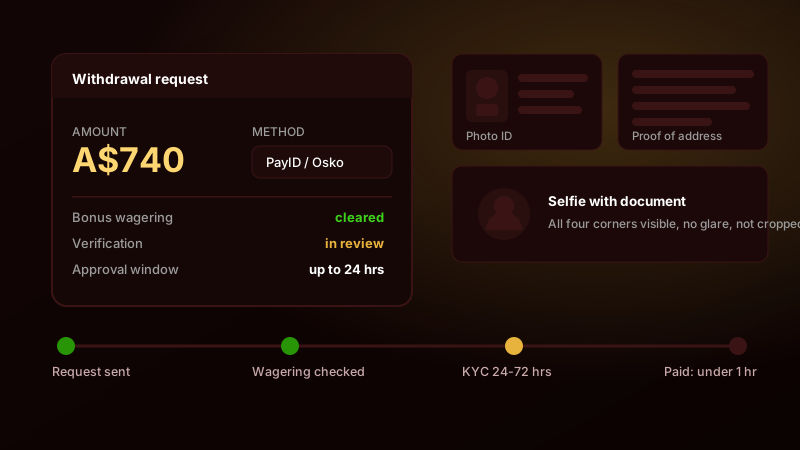
This is the big one, and it is structural. TCL99 lets you deposit and play without verifying your identity, then requires verification before it releases your first payout. So the KYC process (upload photo ID, upload a proof of address, prove you own the payment method, then wait for a human to look at all three) begins at the exact moment you are emotionally invested in getting paid. Every hour of that review feels like a stall tactic. Mostly it is not a tactic at all, just a queue that you joined late.
The fix is boring and it works: complete verification the day you register, before you deposit a cent. Upload the documents while you have nothing pending and no reason to be anxious about the answer. If the operator rejects a document for glare, a cropped corner or a mismatched address, you find out on a quiet Tuesday instead of on the day your A$800 is sitting in “pending”. We describe the whole sequence, document by document, in how to open a verified account.
Cause two: wagering that has not actually finished
The welcome offer is a 100% match up to A$500 plus 100 free spins on a minimum A$20 deposit, carrying 35× wagering on the bonus, typically inside 14 days. Run the arithmetic before you accept it, because a lot of “they refused my withdrawal” complaints are really “I requested a withdrawal with an unfinished bonus attached, and the system voided it”.
A A$100 deposit matched to A$100 of bonus funds means A$3,500 of turnover before that bonus and anything it produced becomes withdrawable. At A$1 spins that is 3,500 spins. At A$2 spins it is 1,750 — assuming your game contributes at 100%, which live dealer tables generally do not. Fourteen days is enough time for that if you play most evenings; it is not enough if you play twice a week. And critically: requesting a withdrawal mid-wagering usually forfeits the bonus balance outright, which players then report as confiscation.
If your goal is to deposit, play a while and cash out, decline the bonus. A clean deposit with no bonus attached has no wagering condition standing between you and your money, and it removes the single most common reason a payout request gets bounced.
Cause three: limits and staged payouts
Offshore casinos commonly cap what leaves in one request and what leaves in one day. Win A$6,000 against a per-request cap and a daily cap, and you are not being refused. You are being paid in instalments across several days, each with its own approval step. From inside the account it looks identical to being stonewalled. Check both caps in your own cashier before you plan a big cash-out, and if you are consistently bumping into them, that is what the higher-tier limits in our breakdown of VIP tier requirements are actually for.
For reference on realistic timing once a request is approved: PayID and Osko generally land within the hour, crypto in roughly 10 to 60 minutes, and bank transfers in one to three business days. Cards take deposits but usually cannot receive payouts at all, which catches out players who deposited by Visa and assumed the money would return the same way. The full timing and limits picture, including what players have publicly reported when things go wrong, sits in our page on reported withdrawal delays.
Cause four: the one that is not a delay
The complaint category that should concern you most is the withheld-winnings case rather than slowness: an operator keeps a balance and cites a rule such as duplicate accounts. At least one such case is publicly documented against this brand. Sometimes the rule was genuinely broken; often it is contested, and the player has no way to test the claim because the evidence sits entirely on the operator’s side of the glass.
Protecting yourself here is mechanical. One account per person, ever. One name on the account, the payment method and the ID, all matching exactly. No shared devices or shared home connections with another player if you can avoid it. No VPN, at any point, because a mismatched login location is the easiest possible pretext for a review. These sound paranoid until the day they are the only reason your balance is not in dispute.
Australian law: the IGA 2001 and where you actually stand
Australians ask two versions of this question. “Is TCL99 legal in Australia?” and “am I breaking the law by playing there?” They have different answers, and confusing them is how people end up either needlessly frightened or wrongly reassured.
The Interactive Gambling Act 2001 is directed at operators. It makes it an offence to provide certain interactive gambling services to people in Australia without the right authorisation, and enforcement (ISP-level blocking, formal warnings, removal from app stores) is aimed squarely at the businesses. The Act contains no offence provisions covering players, and across its entire history no Australian player has been charged, fined or warned for placing a bet on an offshore site. That is the legal position: an offshore casino offering to Australians sits on the wrong side of the operator provisions; the person betting does not commit an offence by betting.
What follows from that is the uncomfortable part. Because the operator is not authorised here, none of the Australian consumer machinery attaches to it. The national regulator cannot arbitrate your dispute. There is no local complaints scheme, no ombudsman, no dispute path that ends with an enforceable order. If TCL99 declines to pay you, the practical options are the operator’s own escalation, public complaint platforms that rely on the operator caring about reputation, and a chargeback attempt with your payment provider that will often fail on the basis that you authorised the transaction. That is the whole ladder.
Sports betting and the in-play rule
One specific consequence catches Australian punters out. Online in-play betting, meaning a bet placed on a match that has already started through a website or an app, is restricted under the same Act, which is why licensed local bookmakers make you telephone them to bet mid-game. Offshore books simply ignore the restriction and offer live markets online. If you use them, you are using a service that is not permitted to be offered here, and you are doing it with no local recourse if a settled bet is disputed.
Where the real protections live
The genuinely enforceable Australian protections are not inside any casino. They sit outside all of them. BetStop, the national self-exclusion register, has operated since August 2023 and carried roughly 49,000 active registrations by the start of 2026; registering blocks licensed Australian operators from accepting you and from marketing to you. Gambling Help Online runs 24/7 on 1800 858 858, free and confidential, and does not require you to have hit a crisis before you call. And the gambling reform legislation passed in August 2026 tightened advertising, direct marketing and opt-out arrangements further. None of these reach an offshore casino directly, but all of them are available to you regardless of where you have been playing, and they are the tools that actually work.
Encryption, data and what happens to your documents
Every TCL99-related domain we opened served over HTTPS with a valid certificate, so the connection between your browser and the site is encrypted. That is genuinely worth confirming, and it is also the least interesting thing about data security in 2026, because it has been standard for a decade. The question that matters is not whether your ID photo is encrypted on the way up. It is what happens to it after it lands.
On that, we found nothing. No published retention period. No named data processor. No stated privacy jurisdiction. No breach-notification commitment. For a business that will require a photo of your driver licence, a utility bill with your home address and a picture of your bank card before it pays you, that silence is a real finding and not a paperwork quibble. You are being asked to hand over the exact document set used for identity theft, to a company whose name you do not know, under a privacy regime that has not been stated.
Practical mitigation, in the order we would do it. Redact everything the operator does not need: cover the middle digits of card numbers and leave only the last four and the name visible. Watermark each image with the words “for TCL99 verification only” and the date, so a copied file has limited resale value. Use an email address dedicated to gambling accounts, never your primary one. Use a unique password stored in a manager, because a breach at an operator you cannot identify will not be announced to you. Enable two-factor authentication if it is offered, and if it is not, treat the account password as the only thing standing between someone and your balance. The sequence is covered in our walkthrough of the account login steps.
Nine rules for playing at an offshore casino
None of this makes an unverified operator safe. What it does is remove the failure modes that are within your control, which on the evidence of the complaint threads is where the overwhelming majority of lost money actually goes. It goes to process rather than to dramatic confiscation: a bonus that voided, a document that was never uploaded, a deposit that was too large for the trust level established so far.
- Verify before you deposit. Complete KYC on day one, while nothing is pending. This eliminates the single largest cause of payout delays outright.
- Test the exit before you trust the entrance. Deposit a small amount, play it, and withdraw whatever survives — even A$40. You are not chasing a profit; you are buying information about whether this cashier pays, and how fast.
- Match every name exactly. Account name, ID name, payment method name. One mismatch is a review; a review is two weeks.
- Screenshot everything. Deposit confirmations, the balance before and after, the withdrawal request with its timestamp and reference, every live chat transcript. If you ever need to escalate publicly, an evidence trail is the difference between a case and a grievance.
- Read the bonus terms as a contract, not an advertisement. Wagering multiple, expiry window, maximum bet while wagering, game contribution percentages, maximum cash-out on winnings. If a term is missing from the page, it exists anyway and will be applied.
- Set a deposit limit in the account on day one. The limit you set while calm is the one that protects you on the night you are not.
- Never chase a stalled withdrawal with a new deposit. It is the most expensive reflex in gambling and it converts a delay into a loss.
- Keep the balance moving out. Money sitting in an offshore account is exposed to every risk on this page. Withdraw at intervals rather than accumulating.
- One account, no VPN, ever. These two rules cover the majority of withheld-winnings disputes in the entire sector.
The escalation timetable, day by day
If a withdrawal does stall, run this schedule rather than improvising. Day 0: screenshot the request, note the reference number, confirm in live chat that verification is complete and nothing is outstanding, then get that confirmation in writing in the transcript. Day 3: if the status has not changed, ask live chat for a specific reason and a specific expected date, and save the answer. Day 7: send a written complaint through every channel available, quoting the reference, the dates, and the timeframe the operator itself advertised. Day 14: file publicly on a complaints platform that mediates with operators, since reputational pressure is a genuine lever on brands that depend on search traffic. Day 21: if you deposited by card and can argue the service was not delivered as described, speak to your bank about your options, understanding that authorised-transaction rules make this an uphill argument. Day 30: assume the balance is not coming back and act accordingly, which means you stop depositing and close the account. Further questions of this shape are collected in our page of player questions about safety.
What checks out and what does not
Compressed to the bones, so you can see both columns at once rather than reading a conclusion we wrote for you.
What checks out
- Real, working platform: deposits clear, games load, payouts do happen
- PayID and Osko land within the hour once a withdrawal is approved, crypto in 10-60 minutes
- Genuine 1,300+ pokie library from Pragmatic Play, NetEnt, Microgaming, Booongo, JILI and Gamzix
- Bonus terms are at least stated: 100% to A$500 plus 100 spins, A$20 minimum, 35x wagering
- 24/7 English live chat that answers
- Australian players face no offence under the IGA 2001 for playing
What does not
- No licence number that resolves to TCL99 in any public register
- The number circulating in its name belongs to a different operator and a different brand
- Operating company, registration number and registered address are all undisclosed
- Independent safety scores of 1.4/10 and 1.0/10, both citing the licence
- Public complaints about withdrawals delayed by weeks, plus a withheld-winnings case
- No retention policy, named processor or privacy jurisdiction published for your ID documents
- No Australian dispute path: no regulator, no ombudsman, no enforceable escalation
Who TCL99 suits, and who should walk away
It might suit you if you are an experienced player who already treats every offshore account as provisional: small balances, fast withdrawals, verification done in advance, one account, screenshots of everything, and a clear-eyed understanding that the money in that account is exposed until it is back in your bank. For that player, TCL99 is a fast cashier attached to a large pokies library, and the transparency gap is a known cost rather than a surprise.
It does not suit you if any of the following is true. You want somewhere to complain if things go wrong, and there is nowhere; no amount of careful play will create one. You are planning to deposit an amount you would be upset to lose to a dispute rather than to variance. You want the bonus specifically and have not run the 35× arithmetic against how much you actually play. You are chasing losses from somewhere else. Or you simply want the reassurance of a name, a number and a regulator behind the site, which is a completely reasonable thing to want and which TCL99 cannot give you.
And a category with no exceptions: if gambling has stopped being entertainment, none of the tactical advice on this page applies to you and none of it will help. BetStop will block licensed Australian operators from accepting you nationwide, and Gambling Help Online is free, confidential and answers 24/7 on 1800 858 858. That call is a better use of the next ten minutes than any casino page, including this one.
The verdict
We set out to answer one question — is TCL99 legit in any sense that protects you — and we will not blur the answer to keep everybody comfortable. The platform is real and it functions. The business behind it is opaque in ways that would fail any regulator’s basic test: no verifiable licence, no named operator, no published data policy, no route of appeal. Independent reviewers scored it near the floor of their scales and gave the same reasons we found independently. Players report withdrawal delays, and while most of those delays trace back to avoidable causes, the fact that avoiding them falls entirely on you is itself the finding.
Play here with your eyes open, small stakes, verification done in advance and money moving out regularly, or else do not play here at all. Both are defensible. What is not defensible is playing here believing you are covered by something, because you are not.
If you have read all of that and still want an account
Verify your identity on day one, decline the bonus unless you have run the 35x maths, deposit small, and withdraw early. Terms shown in your own account are the ones that apply to you.
Visit TCL99 and check the current offer