TCL99 Deposit Methods, Minimums and Processing Times
Funding a TCL99 account from Australia is either the easiest thing on the site or the most annoying, and which one you get is decided before you open the cashier. Send A$100 by PayID from an Australian banking app and the money is in the casino balance before the phone has finished vibrating, with the welcome match appearing underneath it seconds later. That is the good version. The other version is a Visa debit card knocked back twice in the same week by an issuer that never explains itself, a Neosurf voucher refused over one mistyped digit off a faded receipt, and an afternoon spent working out why a bank transfer has not landed by the next morning. This page is all of that written down: what each method costs and how long it really takes, plus the five specific reasons an Australian deposit gets rejected at an offshore casino.
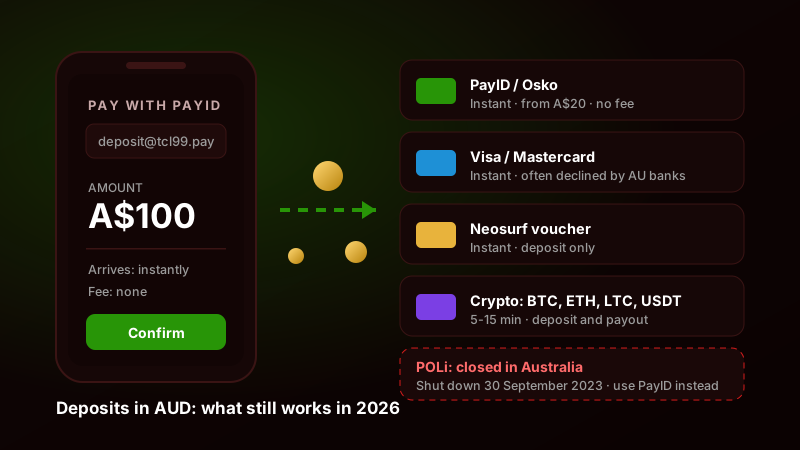
The short answer: what to fund a TCL99 account with in 2026
Use PayID. For an Australian player depositing between A$20 and a few thousand dollars, nothing else on the list is as quick or as reliable, and none of it is cheaper. It settles over the New Payments Platform through Osko and carries no fee at either end, and there is no card network sitting in the middle with the power to refuse the transaction on principle. Crypto is the sensible second choice if you already hold coin. Cards work when they work, and fail often enough that we would not rely on one at 11pm on a Friday with a match offer expiring.
Every method below funds the same single wallet. Deposit once and the balance is available across pokies, live tables and the sportsbook, so there is no separate top-up if you want to fund a sports bet after an hour on the slots. If you are still deciding whether to open an account at all, the TCL99 casino at a glance summary covers the licensing question that sits behind every payment decision on this page.
| Method | Minimum | Maximum | Speed | Fees | Works with the bonus |
|---|---|---|---|---|---|
| PayID (Osko) | A$20 | Set by your bank, commonly A$10,000 a day | Instant, typically under 60 seconds | None at either end | Yes |
| Bank transfer | A$50 | A$25,000 per transfer | Same day to 24 hours, longer across a weekend | None from the casino, your bank may charge | Yes |
| Visa / Mastercard | A$20 | A$5,000 per transaction | Instant when the bank approves it | None from the casino, possible cash-advance fee from your issuer | Yes |
| Neosurf | A$20 | A$500 per voucher | Instant | None online, the retailer prices the voucher | Yes |
| Bitcoin (BTC) | A$20 equivalent | No practical ceiling | 5 to 15 minutes, network dependent | Network fee only, paid to the blockchain | Yes, credited at the rate on arrival |
| USDT (Tether) | A$20 equivalent | No practical ceiling | 2 to 10 minutes on TRC-20 | Around A$1 to A$2 on TRC-20, far more on ERC-20 | Yes |
| POLi | — | — | — | — | No longer available in Australia, the service closed on 30 September 2023 |
Two warnings about that table. The maximums are the ceilings a standard verified account is shown in the cashier, and they move with your verification level and your own bank’s daily transfer cap rather than being fixed once by the casino. And the numbers attached to TCL99 are not consistent between the places that publish them. We found different minimums, different bonus qualifying amounts and different processing windows quoted across review sites and the operator’s own landing pages, so treat everything here as the most consistent version across those sources and read the figures on the cashier screen in front of you before you press confirm.
Deposit speed is not the same as withdrawal speed — cashouts are covered on the withdrawal page.
That chart measures money going in only. Money coming out runs on a completely different clock, gated by identity checks and manual approval, and the gap between the two surprises people. If you want the other half of the picture before you deposit, read how withdrawals work first, because the method you choose now limits what you can cash out to later.
- 1Log in and open the cashier
Sign in, then tap the Deposit button in the top-right of the header or in the account menu on mobile. The cashier opens on the deposit tab with your available methods listed and your AUD balance at the top.
- 2Pick a method and enter the amount
Select PayID, type an amount of A$20 or more, and check whether the bonus toggle is switched on. If you do not want the welcome match, turn it off before you continue rather than after.
- 3Confirm in your banking app
Copy the PayID address and reference shown on screen, open your banking app, send the exact amount to that address, and paste the reference into the description field. The balance updates while you are still looking at the confirmation screen.
- 4Claim the welcome match
The 100% match up to A$500 and the 100 free spins attach automatically to a qualifying first deposit. Open the promotions tab to confirm the bonus balance is showing and the 35x wagering counter has started.
PayID and Osko, step by step
PayID is the reason depositing at an offshore casino from Australia is easier in 2026 than it was five years ago. It rides the New Payments Platform, the same rails your bank uses for instant transfers between friends, and it addresses payments to an email address or phone number instead of a BSB and account number. Osko is the payment service built on top of it, which is why the two names get used interchangeably in cashiers.
What you need before you start
An Australian bank account with PayID enabled, which is every major bank and almost every neobank at this point, and a confirmed email address on your casino account. That second one matters more than people expect. An unconfirmed email is the single most common reason a first deposit is blocked before it even reaches the payment stage, and the error message rarely says so plainly.
The transfer itself
The cashier generates a PayID address and a unique reference code. Both are single-use in practice. Copy them, do not retype them, and send the exact amount you entered in the cashier rather than a rounded figure. A PayID deposit is normally credited in well under a minute, because the NPP settles between Australian banks in near real time and most of the elapsed time is you switching between two apps. The reference is what ties your transfer to your account, and a deposit sent without it goes into a manual queue where it can sit for a day or two until support matches it up by hand.
When PayID goes slow
Instant is not always instant. The NPP occasionally holds first-time payments to a new PayID for up to 24 hours as a scam-protection measure, and several Australian banks now show a warning screen when the recipient is flagged as a gambling-related payee. Send a small first transfer, A$20 will do, so that the payee is established. Subsequent deposits to the same address then move straight through. If your bank refuses to release the payment at all, that is a bank policy decision rather than a casino problem, and no amount of retrying will change it.
Open the TCL99 cashier and deposit A$20 with PayIDBank transfer for larger deposits
A standard bank transfer is the slow, dependable option nobody gets excited about. It has the highest ceiling of any method here and the lowest chance of an outright rejection, which makes it the fallback when a card fails and the deposit is bigger than a Neosurf voucher can carry. The trade-off is time. Money sent on a Friday afternoon can take until Monday to appear, because the receiving side is not an Australian bank and the transfer passes through a payment processor rather than clearing domestically.
The practical advice is to treat a bank transfer as a planned deposit rather than a reaction to a promotion. If a weekend reload offer expires on Sunday night and you initiate a transfer on Saturday, you may find the money arriving after the offer has closed. Keep the transfer receipt until the balance updates. If it has not landed within 24 hours on a business day, support will ask for the reference number, the exact amount and the date, and having a screenshot ready shortens that conversation from days to hours.
Visa and Mastercard: why Australian cards get knocked back
Card deposits at offshore casinos are the least reliable method on the list, and the failure has nothing to do with your balance. Australian banks apply blocks to gambling merchant category codes, most commonly MCC 7995, and several of the big four decline these transactions by default on debit and credit products alike. Since the credit card ban that applies to domestically licensed wagering operators, issuers have become considerably more aggressive about screening anything that carries a gambling code, including transactions routed offshore.
What a declined card actually looks like
You will usually see a generic message in the cashier along the lines of “transaction declined by issuer” or “payment could not be processed”. No explanation comes with either of them. Your banking app may show a pending authorisation that disappears within a few hours, or nothing at all. In some cases the transaction goes through but the issuer processes it as a cash advance, which means interest from day one and a fee of two to three per cent on top. Check your statement after a successful card deposit rather than assuming it cost you nothing.
What to try before you give up on the card
Three things are worth attempting. First, use a debit card rather than a credit card, since debit is screened less harshly. Second, drop the amount below A$200, because some issuers apply a value threshold to unusual merchants. Third, check that the cardholder name in your casino profile matches the embossed name on the card exactly, initials and all. If all three fail, stop retrying. Repeated declines on the same card within a short window will trigger a fraud hold on the card itself, and then you have two problems instead of one.
Neosurf: paying with cash
Neosurf is a prepaid voucher bought over the counter with cash. You hand over money at a newsagent, servo or convenience store, receive a receipt with a ten-digit code, and type that code into the cashier. Nothing about the transaction touches your bank, which is exactly the point for players who would rather their statement stayed clean and who want a hard spending ceiling built into the method itself.
Where to buy one in Australia
Neosurf has a wide retail footprint here, mostly through independent newsagents, convenience stores and some petrol stations. The voucher locator on the Neosurf site is the reliable way to find a stockist near you, and it is worth checking before you drive anywhere, because coverage in outer suburbs is patchier than the map suggests. Vouchers are commonly sold in A$10, A$20, A$30, A$50 and A$100 denominations, with A$500 the usual maximum on a single code.
The voucher problems worth planning around
Two things go wrong with vouchers, and both are avoidable. The first is transcription. The code is printed on thermal receipt paper, the digits blur, and a 0 read as an 8 produces an invalid-code error that looks alarming. Photograph the receipt the moment you get it. The second is that a voucher is bearer money, exactly like cash. Anyone who has the code can spend it, and there is no recovery process if you lose the receipt or leave it on the counter. The other limitation to plan around is that Neosurf is deposit-only. Fund with a voucher and your winnings will have to leave by a different route.
Crypto: Bitcoin and USDT
Crypto sits in an odd middle position. It is the fastest method after PayID and has no meaningful upper limit, and once the coin is sitting in your own wallet no Australian bank can stand in the way of it. The catch is that you have to hold crypto already, because buying it on an exchange first adds a day of verification and a spread that eats into the deposit.
Bitcoin
A BTC deposit clears in roughly five to fifteen minutes depending on network congestion and how many confirmations the casino requires. The cashier issues a one-time deposit address and, on most occasions, a QR code. Send from your own wallet rather than directly from an exchange withdrawal page where possible, since exchange withdrawals sometimes batch transactions and add delay. Never reuse an old deposit address from a previous session.
USDT and the network you choose
USDT is the better option of the two for a straightforward deposit, because it is pegged to the US dollar and does not move in value while it is in transit. The critical detail is the network. TRC-20 costs a dollar or two and settles in a couple of minutes. ERC-20 can cost twenty times that at busy periods. Selecting the wrong network in your wallet is the most expensive mistake available on this page, because coin sent on a network the casino does not support is usually gone for good.
The conversion gap nobody mentions
Your crypto deposit is converted to AUD at the rate the casino applies when the transaction confirms, not when you hit send. On a volatile day that gap is real money. Send A$200 of Bitcoin during a sharp move and the balance credited can be a few dollars either side of what you expected. It is also the reason a crypto deposit occasionally lands one or two dollars under a bonus qualifying threshold. Send slightly more than the minimum if the bonus matters to you.
POLi is gone, and half the internet has not noticed
This is the section that matters most, because it is the one where nearly every competing page about TCL99 payments is still wrong. POLi Payments shut down its consumer service in Australia on 30 September 2023. Australia Post, which had owned POLi since 2014, wound the business up after the major banks progressively stopped supporting it. It is not paused, and it has not been quietly reduced to a handful of banks that still accept it. The service no longer exists as a way to pay for anything in this country.
Why it closed
POLi worked by asking you for your internet banking credentials and then logging into your bank on your behalf to push the payment through. Banks disliked that model intensely and said so publicly for years, on the grounds that it trained customers to hand over their banking passwords to a third party and sat awkwardly against the terms and conditions most account holders had signed. As banks tightened security and rolled out stronger authentication, POLi’s method stopped working reliably, and the arrival of PayID and Osko removed the last reason it existed, since instant bank-to-bank transfers do the same job without anyone screen-scraping a login page.
What to use instead
PayID does everything POLi did, faster and without surrendering your banking login. If you used to deposit by POLi and have not gambled online since 2023, the switch takes about two minutes. Set up a PayID against your phone number or email in your banking app if you have not already, then select PayID in the cashier. The money moves directly from your account to the recipient over the NPP, which is the same infrastructure your bank uses for instant transfers to another person, and your credentials never leave your bank’s own app.
Why other sites still list it
Two reasons, neither flattering. Payment lists on casino review pages are copied from one another and from operator payment feeds, some of which have not been reviewed since 2022. And nobody audits a payments table once it is published, because it is the least glamorous part of the page. The result is that in 2026 you can still find pages recommending POLi for TCL99 deposits, complete with a step-by-step guide for a service that has been dead for nearly three years. If a page tells you to deposit at an Australian-facing casino with POLi, that page has not been checked, and you should weigh everything else on it accordingly.
Fund your account with PayID instead of POLiThe minimum deposit and how it interacts with the bonus
The minimum is A$20, and unusually for this market it is a genuine A$20 rather than a headline figure with a footnote raising it for the promotion. The same A$20 qualifies for the welcome package: a 100% match up to A$500 plus 100 free spins, carrying 35x wagering on the bonus amount and, typically, a 14-day window to clear it.
Deposit A$20 and you receive A$20 in bonus funds, which means A$700 of turnover to convert. A$100 in puts you on the hook for A$3,500. Take the full A$500 match and the requirement becomes A$17,500 inside a fortnight, which is a workload rather than a gift. The ratio holds at every level, so the real question is whether you will realistically play enough to reach the end of it. The full breakdown of the deposit bonus match rate covers which games contribute at what percentage, which changes the answer significantly if you prefer live tables to pokies.
Deposits that do not qualify
A qualifying deposit has to be your first on the account, it has to clear the A$20 floor after any conversion, and the bonus option has to be switched on in the cashier at the time you make it. Crypto deposits that land a dollar short of the threshold because of the exchange rate do not qualify and cannot be topped up afterwards. Neither can a deposit made with the bonus toggle switched off. There is no promo code to enter for the welcome offer, but the field exists in both the sign-up form and the cashier, and knowing where to enter your code when depositing saves a support ticket if a seasonal reload offer does require one.
Why your deposit was declined: five real causes
Almost every failed deposit Australian players describe at offshore casinos falls into one of these five, and the causes barely change from brand to brand. The cashier will not tell you which one, so work down the list in order.
Your bank is blocking gambling transactions
Merchant category code 7995 identifies betting and gambling transactions, and Australian issuers screen it hard. Some banks block it outright on all cards, some allow it on debit only, and some let it through until an internal risk model decides otherwise. If a card fails at every amount and on every attempt while the card works normally elsewhere, this is almost certainly the cause, and PayID is the way around it because it is a bank transfer rather than a card transaction.
The name on the payment does not match the account
The name on your card, your bank account and your casino profile must match. Not approximately, exactly. A card in a maiden name, a joint account in a partner’s name, or a profile registered as “Dan” when the card says “Daniel” will be rejected, sometimes at the payment stage and sometimes later at verification when a withdrawal is requested. Third-party deposits are refused as a matter of policy at every casino operating under anti-money-laundering obligations, and depositing with someone else’s card is the fastest way to have a balance frozen.
You have hit a limit
Three separate ceilings can stop a payment: the casino’s per-transaction maximum, your bank’s daily transfer limit, and any card spending limit you have set yourself. Bank transfer caps are the one people forget, because the default on many Australian accounts is lower than customers assume and can be raised in the app in a couple of minutes. If a A$3,000 deposit fails but a A$500 deposit succeeds, you have found a limit rather than a block.
A VPN is switched on
Payment processors compare the country of your IP address with the country of your payment instrument, and a mismatch is scored as fraud. Connecting through a VPN that exits in Singapore while paying with an Australian bank account is a near-guaranteed rejection, and repeated attempts can flag the account for review. Turn the VPN off for the deposit. If it was on when you registered, expect the geolocation check at verification to raise questions later.
Your account is not confirmed
An unconfirmed email address, an unverified phone number, or an incomplete profile field will block a deposit before the payment is even attempted. This is the quickest fix on the list and the one people skip, because the confirmation email frequently lands in spam or is filtered by a Gmail promotions tab. Check that first, resend if you need to, and complete every field in your profile before you go near the cashier.
Deposit limits, pacing and higher ceilings
The cashier lets you set your own deposit limits on a daily, weekly or monthly basis, and doing it while you are calm rather than mid-session is the point of the feature. A limit takes effect immediately when you lower it and applies after a cooling-off delay when you raise it, which is deliberate and worth knowing before you try to change one on a Saturday night.
At the other end, the standard per-transaction maximums are not fixed forever. Higher ceilings and faster processing attach to loyalty tiers, so if your deposits are regularly bumping against a cap it is worth reading what the VIP deposit limits actually unlock before you split a payment into three transfers. Splitting deposits to get around a cap is also a pattern that compliance systems notice, so ask support to raise the limit rather than working around it.
What we would do with A$100 today
Register, confirm the email immediately, upload identity documents before depositing anything, then send A$20 by PayID as a test transfer to establish the payee with your bank. Once that lands, send the remaining A$80 the same way and decide on the bonus with the terms open on screen rather than from memory. Total time from a standing start to a funded, verified account is about fifteen minutes, and most of that is waiting for the confirmation email.
Skip the card entirely unless PayID is unavailable to you. Keep Neosurf for the situation it is good at, which is a fixed cash budget with no bank trail, and remember you cannot withdraw back to it. Use crypto only if you already hold it, and check the network twice before you send. And if any page, forum post or support script suggests POLi, you are reading something written before September 2023.
Deposit A$20 with PayID and see the balance land
Confirm your email, set a deposit limit you are comfortable with, then fund the account with PayID. It is the only method here that is instant, free and cannot be blocked by a card issuer.
Open the TCL99 cashier