TCL99 VIP Club: Tiers, Points and Real Perks
Loyalty programs are the most oversold thing in offshore casino marketing, and the TCL99 VIP club is no exception. The pitch is a ladder: bet more, climb higher, get a bigger slice of your losses back, jump the queue at the cashier. Every part of that is accurate as far as it goes. What almost nobody does is put a number on it, and once the numbers go in, the ladder looks very different from the way it is presented.
So that is what this page does. TCL99 states one figure openly, 10% weekly cashback on net losses, and we work outwards from there: what the tiers plausibly ask for, what the higher cashback rates are actually worth in dollars, and how much you have to lose before the climb pays for itself. The short version sits at the bottom of the maths section, and it is not flattering. If you want the wider picture on the operator before you commit any volume to it, start with our TCL99 platform review, which covers payouts, the licence question and the independent safety scores.
How the TCL99 VIP club works
The mechanics are the standard ones for this segment. Marketing language has a habit of obscuring them, so here they are in plain terms.
You are enrolled automatically. There is no application, no code and no separate sign-up; the moment you make your first deposit you sit on the bottom rung. From there, every real-money bet you place generates loyalty points at a rate that depends on the game. Points accumulate, thresholds are crossed, and your tier is reviewed on a cycle, monthly at most operators of this size. Move up and your weekly cashback rate rises and your withdrawal ceiling lifts. Above a certain level, a human being is assigned to your account.
Two things are true about that structure at the same time. It genuinely does return money to heavy players who were going to bet the volume regardless. And it is designed, down to the placement of every threshold, so that betting more volume feels like progress instead of expenditure. Neither half cancels out the other, and a player who understands the second one can take the first without being steered by it.
The one number that is not in dispute is the base rate: 10% of your net loss for the week, credited back after the week closes, with no code and no opt-in. Everything above that base (the tier names, the point thresholds, the enhanced rates) is described by the operator in general terms and never published as a table.
The tiers and what each one asks for
Below is the ladder as it works in this corner of the market, mapped against the base rate TCL99 does publish. Treat the point thresholds and the enhanced percentages as a reconstruction of a typical program of this shape, not as quoted terms. Turnover equivalents assume the common accrual rate of one point per A$10 wagered on pokies.
| Tier | Points needed | Weekly cashback | Withdrawal priority | Extra perks |
|---|---|---|---|---|
| Bronze | 0 — automatic on first deposit | 10% (the published base rate) | Standard queue, same manual review as every other account | Weekly cashback, reload offers by email, access to seasonal promotions |
| Silver | 1,000 pts ≈ A$10,000 turnover | 12% | Standard queue, but ahead of unverified first-time cashouts | Birthday credit, occasional targeted reload matches |
| Gold | 5,000 pts ≈ A$50,000 turnover | 15% | Priority review, usually settled the same day | Named account manager, higher single-withdrawal cap, faster limit changes |
| Platinum | 25,000 pts ≈ A$250,000 turnover | 18% | Front of the approval queue, escalation path if a payout stalls | Custom reload offers, raised table limits, invitations to high-limit live rooms |
| Diamond | 100,000 pts ≈ A$1,000,000 turnover | 20% | Top of the queue plus a direct compliance contact | Negotiated deposit and withdrawal ceilings, bespoke offers, event invitations |
That table needs a warning label attached to it, because TCL99 does not publish this ladder anywhere. The operator confirms that a multi-level program exists, that points come from wagering and that higher levels bring better cashback and better withdrawal limits, and it stops there. Nowhere in the public-facing material we compared is there a table of thresholds, a stated rate per tier or a written rule for how a tier is lost. That is not unusual for an offshore brand, but it does mean one thing for you: before you plan any volume around a tier, open live chat and ask support to state your current points, your current rate and the threshold for the next level in writing. Screenshot the answer. If the numbers you are given differ from the shape above, the ones in your account win.
How points are earned and which games count
Points are generated by turnover rather than by deposits or losses. Bet A$10 twenty times and you have wagered A$200 regardless of whether you finished up or down, and it is that A$200 the counter sees. So a player can grind a tier out of a modest bankroll on low-volatility pokies, while a player who deposits A$5,000 and sits on it earns nothing at all.
What varies is the conversion rate, and it varies a lot by game category. The pattern below is the standard weighting across this segment. Again: TCL99 does not publish its own contribution table, so confirm the categories that matter to you before you build a plan around them.
| Game category | Typical contribution | Points per wager | Why it is weighted this way |
|---|---|---|---|
| Standard pokies | 100% | 1 pt per A$10 | Highest house edge and fastest bet cycle, so the most profitable volume to reward |
| Jackpot pokies | ~50% | 1 pt per A$20 | Part of every bet feeds the pooled prize rather than the operator |
| Crash and instant games | ~20% | 1 pt per A$50 | Thin margin and very high turnover per session |
| Live blackjack, roulette, baccarat | 10–20% | 1 pt per A$50–100 | Low house edge and a real dealer cost per table |
| RNG table games and video poker | ~10% | 1 pt per A$100 | Lowest edge on the site, and the easiest to play near-optimally |
| Sports betting | 20–50%, usually only at odds of 1.50 or longer | 1 pt per A$20–50 | Short-priced bets are close to risk-neutral turnover, so they are excluded or discounted |
What that means in practice
The weighting decides who can realistically climb. A pokies player clearing A$500 of turnover in a session (a thousand spins at A$0.50, so one evening’s play) banks 50 points. Silver at 1,000 points is twenty such evenings. Gold is a hundred of them. That is the real shape of the ladder for a normal bankroll, and it is why the tier system is built for a very specific kind of account. The trade-offs and stake maths behind that are set out in more depth on our page covering VIP perks for high-volume slot players.
The same volume at a live blackjack table earns a tenth as much, or less. That is not a glitch. Blackjack played competently costs the house far less, and the weighting reflects it. If your play is mostly at live tables, the loyalty program is close to irrelevant to you, and the useful benefits sit elsewhere: table access, limits and hosting, which we cover under VIP live dealer perks. Chasing points from a blackjack seat is the single most inefficient way to climb this ladder.
Cashback by tier, with the arithmetic
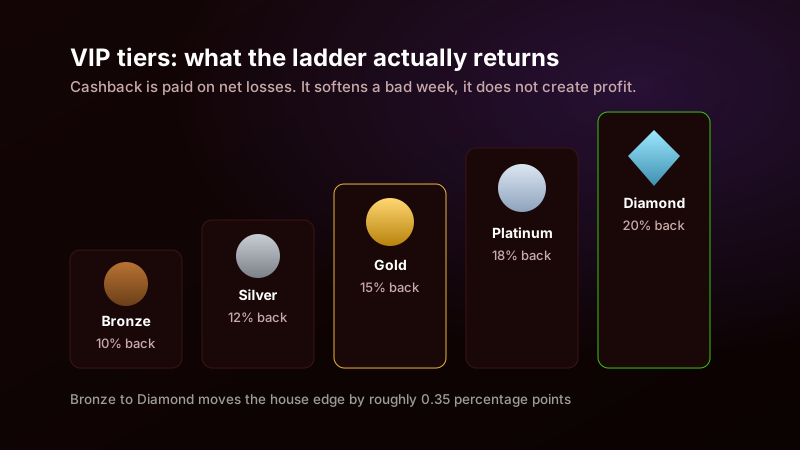
Cashback is a rebate on money you have already lost, not a return and not earnings of any kind. A week in which you receive A$200 back is a week in which you were about A$1,000 down. Hold that in your head while reading the chart, because the presentation of loyalty cashback across this industry is built to make you forget it.
Cashback is paid on net losses, so it only exists when the week went badly - it is a rebate, not a profit.
Scaled across the loss sizes a real account actually produces, the gap between the bottom and the top of the ladder looks like this. A losing week of A$250 returns A$25 at Bronze and A$50 at Diamond. A losing week of A$500 returns A$50 against A$100. At A$1,000 it is A$100 against A$200, and at A$2,500 it is A$250 against A$500. In every row the top of the ladder is worth exactly one extra dime on the dollar compared with the bottom, which sounds substantial until you remember what you had to do to get there.
The edge calculation, which is the number that matters
There is a cleaner way to read cashback than in dollars, and it is the way the operator reads it. Cashback shaves the house edge down a little. It never reverses it. Pokies at TCL99 sit around 96.5% RTP, so the house edge on your turnover is roughly 3.5%. Apply cashback to that and you get your effective cost of play:
- Bronze, 10% cashback: 3.5% × 0.90 = an effective edge of 3.15%
- Silver, 12%: effective edge 3.08%
- Gold, 15%: effective edge 2.98%
- Platinum, 18%: effective edge 2.87%
- Diamond, 20%: effective edge 2.80%
Read that list again. The entire ladder, from the rung you are placed on for free to the rung that costs a million dollars of turnover, is worth 0.35 percentage points of house edge. On A$50,000 of lifetime wagering, that difference is A$175. Every rate on that list is still negative. Cashback makes losing slower; it does not make winning likelier, and no tier on any ladder changes what the random number generator does.
One quirk that genuinely works in your favour
Weekly settlement is better for the player than monthly settlement, and the reason is mechanical. Cashback is calculated per week, so a winning week simply pays nothing and does not get netted off against the losing weeks around it. If you lose A$800 in week one and win A$800 in week two, your net position for the fortnight is zero, but you still collect cashback on the A$800 loss. Over a year of choppy results, that quirk pays out meaningfully more than 10% of your annual net loss. It is the one structural detail of this program that is unambiguously on your side, and it is worth confirming with support that TCL99 settles weekly rather than on a rolling monthly balance.
What the terms do not say
Two questions about cashback are unanswered in everything we could find, and both change its value substantially. Is the credit paid as withdrawable cash or as bonus funds carrying a wagering requirement? And is there a weekly cap? At the base rate, a bad A$5,000 week would generate A$500 in cashback, and most operators of this size put a ceiling somewhere below that number. Ask both questions in chat before you assume the figure in the chart applies to you at scale. If the answer is that cashback lands as bonus funds at 35×, the same multiplier attached to the standard welcome offer, then A$200 of cashback carries A$7,000 of turnover behind it, and it is worth a small fraction of its face value.
Check the current TCL99 cashback terms in your accountWithdrawal limits and payout speed for VIP players
This is where tier status delivers its most tangible benefit, so it pays to understand exactly which part of the process it accelerates.
A TCL99 withdrawal has two stages. First the request sits in a manual approval queue, where a human checks your verification status, your bonus position and your play history. Then it hits the payment rail. The rail is fast and does not care about your tier: PayID and Osko land within the hour of approval, crypto in ten to sixty minutes, bank transfer in one to three business days. The queue is the variable, and the queue is what a tier buys. On a standard account the approval step is where hours or days disappear; at Gold and above your request is flagged for priority review, which is the entire mechanism behind faster VIP payout times.
What a tier does not buy is an exemption from verification. Every account, at every level, clears KYC before the first payout: identity document, proof of address, and proof of the payment method. Nobody skips it, and the fastest thing any player can do for their own cashout speed, tier or no tier, is complete verification on day one rather than at the moment they first want their money.
On limits: TCL99 does not publish its withdrawal ceilings by tier. Across comparable offshore operators, the base account typically sits between A$4,000 and A$5,000 a day with a monthly cap several multiples of that, and top-tier accounts negotiate individually rather than working to a published number. The same pattern applies on the funding side, where the ceilings that get raised as you climb are set out with the rest of the payment mechanics under higher deposit limits for VIP. If a specific limit matters to your plans, say because you intend to move A$10,000 in a week, get it confirmed in writing before you deposit rather than after you have a balance you cannot move.
The personal manager: what you get and what it costs you
At Gold and above you are typically assigned a named contact. Understanding what that person is measured on is the most useful thing on this page after the maths.
An account manager at an online casino is a retention role. Their performance is judged on the net deposits of the accounts they hold: how much their players fund, how often they come back, how quickly a lapsed account is reactivated. They are not neutral and they are not your advocate by default. The friendliness is usually genuine, and it is also the product.
What they are genuinely useful for
Used deliberately, the relationship has real value. A manager can push a stalled withdrawal past a compliance queue in an afternoon rather than a week. They can raise a limit without a formal request. They can give you a direct answer on questions the public terms leave open: whether cashback is cash or bonus, what your exact points balance is, what the next threshold is. And when something genuinely goes wrong, having a named person who has already replied to you in writing is worth considerably more than a generic support ticket.
Where it turns against you
The catch shows up in the timing. Offers arrive when you are down, because that is when a deposit is most likely. A reload match a few hours after a heavy loss, a “top up A$500 and I will add A$250” on a Sunday evening, a message on a personal channel late at night. The matched money almost always carries the same 35× wagering as everything else, which means an offer that reads like compensation is in practice a request that you deposit again and turn over a large multiple of the amount.
Four rules make the relationship safe to have. Keep every conversation in writing, inside the site’s own chat, so there is a record. Never accept a deposit offer within an hour of a loss, and never one you would not have taken on a neutral day. Ask for the full terms of any offer as text before you accept anything; a manager who will not put the wagering multiplier in writing has told you what you need to know. And remember you can ask to be moved back to standard support at any time, because a manager is a service rather than an obligation, and declining one costs you nothing except the priority queue.
Is chasing a tier worth it? The honest arithmetic
This is the calculation nobody in this industry publishes, because the answer is bad for business.
Climbing a tier means putting turnover through the site. Turnover at a 3.5% edge costs you money in expectation, which is what an edge means. So each rung has a price in expected losses: A$10,000 of turnover to reach Silver costs about A$350, A$50,000 to reach Gold costs about A$1,750, A$250,000 for Platinum costs about A$8,750, and the million dollars of turnover behind Diamond costs about A$35,000. Base cashback returns roughly a tenth of that along the way, so call the net cost of the climb to Gold about A$1,575.
Now price the reward. Each A$10,000 of subsequent turnover produces about A$350 of expected loss, and the tier uplift pays a percentage of that. Silver’s extra two points is worth A$7 per A$10,000 wagered. Gold’s extra five points is worth A$17.50. Platinum’s eight points is worth A$28, and Diamond’s ten points is worth A$35. Divide the climb cost by the uplift and you get the turnover needed to break even:
| Tier reached | Turnover to get there | Expected cost of the climb | Uplift per A$10,000 wagered | Further turnover to break even |
|---|---|---|---|---|
| Silver | A$10,000 | ~A$315 after base cashback | A$7 | ~A$450,000 |
| Gold | A$50,000 | ~A$1,575 after base cashback | A$17.50 | ~A$900,000 |
| Platinum | A$250,000 | ~A$7,875 after base cashback | A$28 | ~A$2,800,000 |
| Diamond | A$1,000,000 | ~A$31,500 after base cashback | A$35 | ~A$9,000,000 |
That is the whole answer in one table. Betting extra volume specifically to reach a tier never pays for itself, because the rebate returns at most twenty cents of every dollar you lose to get it. You would need roughly A$900,000 of further turnover to recover what the climb to Gold cost you, and by the time you have wagered that, the losses attached to it dwarf every dollar of cashback the tier ever paid.
Which leaves exactly one sensible way to treat this program. If you were already going to wager the volume, take the tier: it is free money on losses you were taking anyway, and refusing it would be silly. If you are considering extra sessions, larger stakes or an unplanned deposit because a threshold is close, stop: the threshold is costing you more than it will ever return. A tier is a discount on a purchase rather than a reason to make one, and every element of the presentation is built to blur that distinction.
How you lose a tier
Tiers are not permanent, and the rules for losing one are the least documented part of the whole system. The three mechanisms in general use across this segment are worth planning around.
Rolling windows. Most programs count points earned within a fixed lookback, commonly 30 or 90 days, rather than for life. Your status reflects recent volume, so a quiet month can drop you a rung even though your lifetime turnover has not changed.
Inactivity downgrades. A dormant account of 60 to 90 days typically falls one level, and continues falling. Points balances themselves may also expire on their own clock, separate from the tier.
Terms breaches. Duplicate accounts, bonus abuse patterns and failed verification remove status entirely and generally take the accumulated points with it. This is the fastest way down and the only one that is not reversible by playing.
None of these windows is published by TCL99, so if you hold a tier that matters to you, ask support two specific questions: over what period are my points counted, and after how long without a bet does my level drop? A clear answer tells you whether the status is worth maintaining. If what comes back is vague, do not build any plans on it.
Playing at VIP volume without losing control
The volume figures on this page are large, and it would be dishonest to print them without saying so plainly. Silver sits at A$10,000 of turnover and Gold at A$50,000. Those are real sums of money moving through an account rather than abstractions, and at a 3.5% edge the expected losses attached to them are A$350 and A$1,750 respectively. Anyone in that territory should have limits set before they get there, not after.
Deposit limits are the most effective single control, because they cap the input rather than trying to govern behaviour mid-session. Set a weekly figure you would be comfortable losing entirely, and set it while you are calm rather than after a bad night. Loss limits and session reminders help; a cooling-off period is available at most operators and takes effect immediately. The pattern to watch for in yourself is specific to this page’s subject: depositing to reach a threshold, extending a session because a level is close, or accepting a manager’s reload because it will move the counter. All three are the program working exactly as designed.
If you want a harder stop, BetStop is Australia’s National Self-Exclusion Register, and one registration blocks you from every Australian-licensed interactive wagering service. Be clear about its reach, because this matters here: an offshore operator such as TCL99 is not bound by that register, so BetStop is not complete cover on its own. It should be paired with the operator’s own self-exclusion tool, and if you are dealing with more than one site, with a bank-level gambling block through your banking app, which most Australian banks now offer. Free, confidential help is available around the clock from Gambling Help Online on 1800 858 858. Gambling is 18+ and is entertainment with a price, not a way to make money.
The verdict on the TCL99 VIP club
What the program genuinely gives you
- 10% weekly cashback runs automatically with no code, no opt-in and no minimum tier
- Weekly settlement means winning weeks are not netted off against losing ones, which pays out more than an annual calculation would
- Priority approval at Gold and above cuts the slowest part of a withdrawal, which is the manual review rather than the payment rail
- A named manager is a real escalation path when a payout stalls or a limit needs raising
- Points accrue on turnover, so a disciplined low-stakes player can climb without a large bankroll
- Nothing has to be bought or claimed — enrolment is automatic on the first deposit
What it does not
- The whole ladder is worth 0.35 percentage points of house edge, from bottom rung to top
- Chasing a tier never pays for itself: roughly A$900,000 of further turnover is needed to recover the climb to Gold
- Thresholds, rates, caps and reset windows are not published anywhere we could verify
- It is unclear whether cashback arrives as withdrawable cash or as bonus funds carrying wagering
- Live tables and RNG games earn points at a tenth of the pokies rate or less
- The account manager is a retention role, and the offers arrive precisely when you are down
Our position is straightforward. The base cashback is the best thing TCL99 offers a regular player, and over a full year it beats the welcome package, because it needs no wagering decision from you and it keeps applying long after the sign-up offer is gone. Take it. It costs nothing and it softens genuinely bad weeks.
The ladder above it is a different proposition. Reaching Gold is worth having if you were going to wager A$50,000 anyway, and it is a poor reason to wager A$50,000 if you were not. Decide which of those two sentences describes you before you look at your points balance again, because the program is engineered so that the balance itself makes the argument. Set your deposit limit first, verify your account early, ask support to put your rate and threshold in writing, and treat every percentage point of cashback for what it is: a partial refund on money that has already gone.
Start at the base rate before you think about tiers
Every account gets 10% weekly cashback on net losses from the first deposit, with no code and no minimum level. Verify your identity early so priority withdrawals actually mean something, set a deposit limit you are comfortable with, and ask support to confirm your points and rate in writing before planning any volume.
Open a TCL99 account