TCL99 Live Casino: Tables, Providers and Betting Limits
A live table is the only part of an online casino where you can watch the cost of your own decisions in real time. There is no return-to-player badge in the corner of the screen, no demo mode, and no way to pause and think. What there is instead is a set of published rules on the felt, and those rules decide how much every A$100 you put across the table is going to cost you over a long enough run. We went through the TCL99 live floor table by table over several days, catalogued the limits it publishes, read the rule card on every felt, and did the arithmetic that the lobby tiles never show you.
This page is about that arithmetic. Which wheel to sit at and which to walk past, what separates a blackjack table worth playing from one that quietly triples its own margin, why baccarat is mathematically the cheapest seat in the room, and what game shows really charge for the confetti. If you want the broader picture on the operator first (payouts, verification, the licence question), start with the TCL99 overall rating and come back here once you have decided you want an account at all.
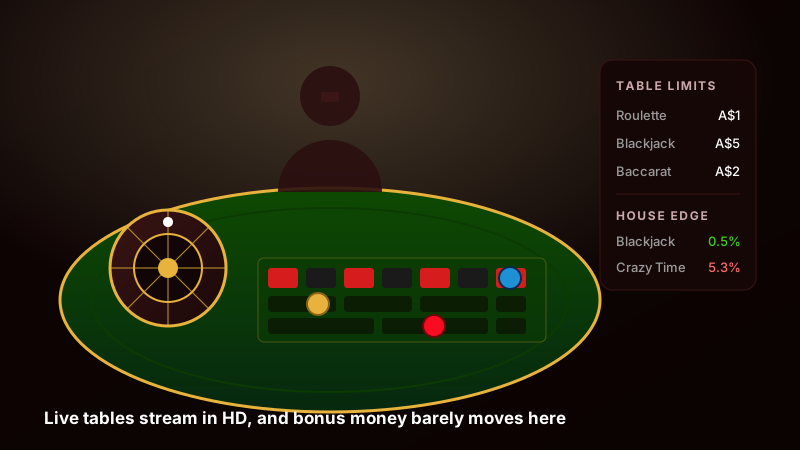
What the TCL99 live floor actually is
Nothing you see in the live section is made by TCL99. Offshore casinos of this size do not build studios; they license feeds from the same handful of suppliers everyone else uses, and then wrap them in their own lobby skin. That is not a criticism. It is the reason the games are fair enough to analyse in the first place, because the wheels, shoes and rule sets are standardised across every operator carrying the same feed.
Who runs the tables
The titles in the lobby give the suppliers away. Lightning Roulette, Crazy Time and Dream Catcher are studio products from the market-leading live provider, and their maths is identical wherever you find them. Pragmatic Play, already the largest name in the TCL99 pokies catalogue, runs its own live studio and supplies a second set of roulette, blackjack and baccarat tables under its branding. In practice that means roughly thirty-plus tables open at any given time, with the count rising during European studio peak hours and thinning out to a core of auto-roulette and always-on baccarat overnight.
The dealers work in English. On the studio feeds that means a trained, genuinely fluent dealer rather than a machine reading a script, and a moderated chat window alongside the table. Do not expect an Australian-hosted table: these studios sit in Europe, and the practical consequence for you is a timing one rather than a language one.
When the floor is busiest from Australia
Central European evening is Australian early morning. The widest table selection, the highest-limit private rooms and the fullest game-show schedule all land between roughly 4am and 9am AEST, which is exactly when most Australians are asleep. Play at 8pm on a Sydney evening and you get a thinner floor: fewer blackjack seats, fewer high-limit rooms, more auto-roulette. It is not a problem, because the maths of a table does not change with the hour. But if you have ever wondered why every blackjack seat is taken on a Tuesday night, that is your answer. Infinite Blackjack, which has no seat cap, exists precisely for this.
Every live table, limit and house edge in one view
Here is the floor as a spreadsheet. House edge is expressed the way it should be: the long-run cost of every A$100 you wager, not a prediction about tonight. Limits are the ones published on the standard tables in September 2026, taken from the lobby’s own information panels and outside the VIP rooms.
| Table | Game type | Min bet | Max bet | House edge | Best for |
|---|---|---|---|---|---|
| European Roulette | Live roulette, single zero | A$1 | A$10,000 | 2.70% | The cheapest wheel in the room and the default choice |
| Lightning Roulette | Live roulette with multipliers | A$1 | A$5,000 | 2.90% on straight-up numbers, 2.70% outside | Players who want big multipliers and accept a worse straight-up price |
| Auto Roulette | Automated single-zero wheel | A$1 | A$5,000 | 2.70% | Overnight play when the staffed tables are thin |
| Classic Blackjack | Live blackjack, seven seats | A$5 | A$5,000 | About 0.5% with correct basic strategy | The lowest edge on the floor, if you learn the chart |
| Speed Blackjack | Live blackjack, accelerated | A$5 | A$3,000 | About 0.5%, but roughly twice the hands per hour | Experienced players only, since speed multiplies your hourly cost |
| Infinite Blackjack | Unlimited-seat blackjack | A$1 | A$5,000 | 0.5% to 0.7% depending on the six-card rule | Peak hours, when every seated table is full |
| Baccarat | Live baccarat, commission | A$1 | A$15,000 | 1.06% Banker, 1.24% Player, 14.36% Tie | The best price on the floor with zero decisions to make |
| Speed Baccarat | Live baccarat, 27-second rounds | A$1 | A$10,000 | Same 1.06% Banker, three times the round rate | Players who find standard baccarat slow, at triple the hourly cost |
| Crazy Time | Game show, four bonus rounds | A$1 | A$2,500 per segment | About 5.3% on a spread; 3.9% to 5.6% by segment | Entertainment. It is the most expensive seat here |
| Dream Catcher | Game show, money wheel | A$1 | A$2,500 per segment | 3.4% on segment 1, up to 4.9% on segment 40 | The simplest game show, and cheaper than Crazy Time |
House edge is the long-run cost of each A$100 wagered; it does not predict a single session.
Read that chart once more, because it is the single most useful thing on this page. The gap between the top and bottom bars is a factor of ten. A player who does nothing but move from Crazy Time to correctly played blackjack has cut the long-run cost of their hobby by roughly ninety per cent without reducing their stake by a cent.
Since we are dealing in numbers, one warning about where they come from. Published figures for TCL99 do not agree between sources. Different listings quote different table counts, different minimums and different bonus terms, and the operator’s own pages have carried different figures at different times. The limits in the table above are the ones the lobby was publishing in September 2026, and limits in particular get adjusted quietly and often. Open the table’s own information panel in the lobby before you sit down and treat the number on the felt as the only one that binds you.
Open the TCL99 live lobby and check today's table limitsLive roulette: the wheel you pick decides the price
Roulette is the easiest game in the building to get wrong, because two wheels that look nearly identical charge completely different prices, and the lobby tile does not tell you which is which. You have to open the table and count the zeros.
European versus American: the same game at double the cost
A European wheel has 37 pockets: numbers 1 to 36 plus a single zero. A straight-up number pays 35 to 1, which means the true odds are 36 to 1 and the house keeps the difference. Work it through and the edge is 2.70% on every bet on the layout. An American wheel adds a second pocket, the double zero, for 38 in total, without changing a single payout. The edge jumps to 5.26%.
The gap between those two numbers is the entire cost of playing, doubled. Put it in dollars. At A$5 a spin and a realistic 45 spins an hour on a staffed table, the European wheel expects to take A$6.08 an hour from you. The American wheel expects A$11.84. Over twenty hours of play across a few months, that is A$122 against A$237 for exactly the same experience, the same dealer, the same stakes and the same chance of a good night. There is never a reason to sit at a double-zero wheel when a single-zero one is open in the same lobby.
French rules and la partage
If a French-rules table is running, it is the best roulette price available anywhere. The wheel is the same single-zero wheel, but the la partage rule returns half of any even-money bet (red or black, odd or even, high or low) when the ball lands in zero. That halves the edge on those bets specifically, from 2.70% to 1.35%. It changes nothing for straight-up numbers. French tables are not always in the TCL99 lobby and tend to appear during European peak hours, which for Australians means early morning. If you see one and you play even-money bets, take it.
Lightning Roulette: multipliers you pay for
Lightning Roulette is the most popular table on most live floors, and the trade behind it repays a minute of thought rather than just an enjoyment of the animation. Each round, between one and five numbers are struck and given a multiplier of 50x up to 500x. If you have a straight-up bet on one of them, you get an enormous payout. The funding for that comes out of the standard straight-up return: a winning straight-up bet that has not been struck pays 29 to 1 instead of 35 to 1.
Net result: the house edge on straight-up bets rises from 2.70% to 2.90%. Outside bets are untouched and stay at 2.70%. That is a small premium in percentage terms, and if you genuinely want the multiplier lottery, it is a defensible way to buy it. It still remains a slightly worse bet than the plain European wheel, with a much longer tail on the payouts, which some people value and plenty of others should ignore. The thing to do is play it on purpose, rather than by accident because the tile happened to be the flashiest one on the screen.
Live blackjack: the rules on the felt matter more than the cards
Blackjack is the only game on the floor where your own decisions change the house edge, which is why it is both the cheapest game available and the one where most players do the most damage to themselves. A correctly played hand on a good table costs about A$0.50 per A$100 wagered. The same hand played on instinct at a badly ruled table can cost five or six times that.
3:2 versus 6:5: the most expensive line on the table
Before anything else, find the payout for a natural blackjack. It is printed on the felt and repeated in the table information panel. You want 3:2. A A$10 hand that hits blackjack pays A$15 at 3:2 and A$12 at 6:5. Three dollars does not sound like a tragedy until you remember that a blackjack lands on roughly 4.75% of hands, about once every twenty-one hands, which at a live pace is two or three times an hour, every hour, forever.
Priced properly, the 6:5 payout adds about 1.39 percentage points to the house edge. It takes a table that was costing you 0.5% and turns it into one costing roughly 1.9%. You have not changed how you play; you have almost quadrupled the price of playing. If a TCL99 blackjack table shows 6:5, close it and open another. There is no strategy adjustment that recovers that money, because the rule takes it before you make a single decision.
The other four rules that move the number
Once the payout checks out, four more lines on the rule card are worth reading. First, whether the dealer stands or hits on soft 17. Standing (S17) is better for you by about 0.22%. Second, whether doubling after a split is allowed; permitting it is worth about 0.14% in your favour. Third, whether late surrender exists. The option to fold half your bet against a strong dealer card is worth around 0.08%, and it is rarer on live tables than it is on software ones. Fourth, deck count: fewer decks are marginally better, though at eight decks versus six the difference is only a few hundredths of a percent and not worth chasing.
Added together, a table with 3:2, S17, double-after-split and surrender sits near 0.4% to 0.5%, while a table with 6:5 and H17 sits close to 2%. In the lobby the two of them look identical, with the same dealer smiling at the same camera, and the whole of that difference sits in a panel most players never think to open.
Basic strategy, compressed
Basic strategy is no system and it will not beat the house. All it gives you is the mathematically correct decision for every combination of your hand and the dealer’s upcard, and playing it is what turns a 2% game into a 0.5% one. The full chart fits on a card; here is the spine of it.
Always split aces and eights, never split tens or fives. Double a hard 11 against any dealer card except an ace, and a hard 10 against a dealer 2 through 9. Stand on hard 17 or better, always. On hard 12 through 16, stand when the dealer shows 2 through 6 and hit when the dealer shows 7 through ace, since a dealer holding a low card is far more likely to bust than one holding a high card. Never stand on a soft 17; hit it or double it. And hit any hard total of 8 or less without thinking about it.
That covers the large majority of hands you will be dealt. The remaining edge cases are worth learning from a proper chart, but a player who follows only the paragraph above is already playing a far cheaper game than the person beside them agonising over a 16 against a dealer ten.
Insurance and side bets
Decline insurance. Every time. When the dealer shows an ace, you are offered a side wager at 2 to 1 that they hold a ten in the hole. With eight decks in play the actual probability is close to 30.8%, and you need 33.3% to break even. The house edge on insurance runs roughly 6% to 7% against you, which makes it one of the worst bets available at a blackjack table — considerably worse than the roulette wheel next door. The fact that it is offered at the tensest moment of the hand is not an accident.
Side bets follow the same pattern. Perfect Pairs, 21+3 and the various bonus wagers carry house edges commonly between 3% and 11% depending on the paytable. They are entertainment priced like game shows, sitting on a table that otherwise offers the best odds in the building. Nothing stops you playing them; just be clear that A$5 on a side bet costs you roughly ten times what A$5 on the main hand costs.
Speed and Infinite Blackjack
Speed Blackjack deals to whoever acts fastest and runs roughly 80 to 100 hands an hour against 40 to 60 at a standard seven-seat table. The house edge per hand is unchanged. Your hourly expected loss roughly doubles, because you are pushing twice as much money across the felt. That is a completely reasonable trade if you understand you are making it, and a slow financial bleed if you do not.
Infinite Blackjack solves the seat problem: unlimited players are dealt the same dealer hand and each plays their own. The Six Card Charlie rule, an automatic win on six cards without busting, is a small gift, though the seat is usually paired with optional side bets designed to claw that gift straight back. Play the main hand, skip the extras, and it is a perfectly good table.
Live baccarat: the cheapest hand on the floor
Baccarat has a reputation for being complicated, which is backwards. It is the simplest game in the room because you make no decisions at all. You bet on Banker, Player or Tie, the dealer follows a fixed drawing rule that neither you nor they can influence, and the hand closest to nine wins, which is as far as the rules go.
Banker, Player and the tie trap
Banker carries a house edge of 1.06%. Player carries 1.24%. Both are excellent by casino standards, cheaper than any roulette wheel and beaten only by well-played blackjack. Banker wins slightly more often than Player because of the drawing rules, which is exactly why the commission exists.
The Tie bet is a different animal. At the standard 8 to 1 payout the house edge is 14.36%. That is more than double what Crazy Time costs and roughly fourteen times the Banker bet sitting next to it on the same felt. Some tables pay 9 to 1, which improves it to 4.84% and still leaves it the worst wager on the table. Bet Banker or bet Player, and alternate between the two if you enjoy the ritual, but leave the tie alone.
Commission and no-commission tables
Standard baccarat charges 5% commission on winning Banker bets. That deduction is what produces the 1.06% figure; it is already priced in, and a A$100 Banker win pays A$95. No-commission tables remove the deduction and look better at a glance, but they compensate by paying only half on a Banker win with a total of six. That single change lifts the Banker edge from 1.06% to about 1.46%. If both are open, the commission table is the better value, however irritating the bookkeeping feels.
Speed Baccarat and the roadmaps
Speed Baccarat compresses a round into about 27 seconds and delivers roughly 90 to 100 hands an hour, against 35 to 40 at a standard table. Same 1.06%, close to triple the turnover, close to triple the hourly cost. The pattern is identical to Speed Blackjack and deserves the same warning.
Then there are the roadmaps: the bead plate, big road, big eye boy and the rest of the grids that fill half the screen. They are a genuine and centuries-old part of baccarat culture, and they are also a record of results that have already been settled. Each shoe is dealt from a shuffled shoe with a fixed drawing rule; a run of eight Banker wins tells you exactly as much about the ninth hand as a run of eight reds tells you about the next spin, which is nothing. Enjoy the pattern if you like it, but do not size a bet on it.
Game shows: Crazy Time, Dream Catcher and what you pay for the noise
Game shows are the fastest-growing category in live casino and the most expensive one on the floor. That is a deliberate design: production values, hosts, physical props and bonus rounds cost money to run, and the house edge is where that money comes from.
Crazy Time runs a 54-segment wheel with four bonus rounds: Coin Flip, Pachinko, Cash Hunt and Crazy Time itself. The return varies by which segment you back: the plain number bets sit around 3.9% to 4.3% against you, while the bonus-round segments run from roughly 4.7% up to 5.6%. A player spreading across the board the way most people actually play lands near 5.3%. Dream Catcher is the stripped-back version, a money wheel with segments running from 1 to 40, and it is materially cheaper, from about 3.4% on segment 1 to 4.9% on segment 40. If you want the format, Dream Catcher is the better-priced way to have it.
None of this makes game shows a bad way to spend an evening. They are the most watchable thing in the lobby and a A$1 minimum keeps a long session genuinely affordable. Just hold the comparison in your head: an hour of Crazy Time at A$5 a round expects to cost you around A$12, while an hour of correctly played blackjack at A$10 a hand expects to cost about A$3. You are paying roughly four times as much for a game with half the stake. If that is a fair price for the entertainment, then it is a fair price, as long as you know that you are paying it.
Betting limits, table by table
Live limits are set per table, not per casino, and they move. The floor at TCL99 runs from a A$1 minimum on baccarat, auto-roulette and the game shows up to A$15,000 on a single baccarat hand at the top standard table. Blackjack minimums start higher, at around A$5, because a seated table with a human dealer has to be worth running.
How to read the limits in the lobby
Every tile shows a range, and the range is the minimum and maximum for the main bet only. Three things it does not show you. Side bets carry their own, usually lower, caps. Outside and inside bets on roulette have separate maximums, so a A$5,000 table max on a straight-up number does not mean A$5,000 on red. And progressive or multiplier bets are capped separately again. Open the information panel, tap through to the limits tab, and read the full grid before you plan a session around a number you saw on a tile. Make sure you deposit before joining a live table as well: unlike pokies, there is no demo mode here, and a table with an empty balance will simply not seat you.
VIP and high-limit rooms
Above the standard floor sit private and VIP tables with minimums starting where the public tables end, typically A$50 to A$100 a hand, and maximums well beyond A$15,000. Access is tied to loyalty status rather than a single large deposit, so if high-limit play is the point for you, the tier requirements and what they unlock are covered under VIP access to live tables. For everyone else the practical note is simpler: the house edge in the VIP room is identical to the house edge on the public table. A more expensive seat is not a better-priced game.
Join a live table at TCL99 from A$1Connection, device and what happens if you drop out
Live casino is video streaming with money attached, and it fails the way streaming fails. Understanding that in advance is worth more than any betting pattern.
What you actually need
A standard-definition table feed uses roughly 1 to 2 Mbps. Full HD needs about 5 Mbps, and a multi-table view needs more again. Stability matters far more here than peak speed: a connection that averages 50 Mbps and then drops to nothing for four seconds every minute is worse for live play than a steady 6 Mbps line. Wired or good Wi-Fi beats mobile data. Mobile data on a strong 4G or 5G signal is fine; mobile data in a lift, a train tunnel or a crowded venue is not.
On the device side, any phone or tablet from the last four or five years handles a single table. What causes trouble is thermal throttling on a long session, a low-power mode that throttles the CPU, or fifteen background tabs competing for memory. Close them. If you plan to stream live tables on mobile, plug the phone in. An hour of HD video will visibly drain a battery, and a device dying mid-hand causes exactly the same problem as a dropped connection.
The moment the stream dies
This is the part players assume works in their favour and it does not. Once a bet is accepted by the server, it is live. Your video feed is a broadcast of a game that is being settled elsewhere; losing the picture does not pause the dealer, cancel the round or refund the stake.
What happens next depends on the game. On roulette, baccarat and the game shows there is nothing left for you to decide, so the round simply resolves and the result is waiting in your history when you reconnect. On blackjack, where a decision is pending, the table applies its own automatic rule, which usually means standing on your current total when the decision timer runs out. That means a disconnection while sitting on 12 against a dealer six will very likely stand you on 12, which is at least the correct play. A disconnection while sitting on 8 will stand you on 8, which is not.
The practical rules follow from that. Do not play live blackjack on a connection you do not trust, and stay off the public Wi-Fi in a café or an airport. If you use a VPN, understand that it adds latency, can drop mid-session, and may sit awkwardly against the operator’s terms. An account flagged at verification is a far more expensive problem than a slow stream. And if the feed does die, reconnect and check the history before assuming anything about what you won or lost.
Data usage on mobile
Budget roughly 700MB to 1GB per hour for an HD live table, and less for standard definition. A three-hour session on mobile data is a couple of gigabytes. Most Australian plans absorb that without noticing, but if you are on a limited allowance, drop the stream quality in the table settings — the game is identical, the picture is just softer, and the data cost falls by more than half.
Why bonus money barely moves at a live table
This is the section we would most like every player to read before depositing, because it is where the largest number of avoidable complaints begin.
Contribution rates
The TCL99 welcome package is 100% up to A$500 plus 100 free spins, carrying 35× wagering on the bonus amount, from a A$20 minimum deposit. Take the maximum and you are looking at A$17,500 of turnover to clear it. That is a big number even at full contribution.
Live tables do not pay full contribution. Across offshore casinos generally, pokies count at 100% while roulette, blackjack and baccarat count at 10%, at 5%, or (most commonly on live dealer specifically) at zero. Run the arithmetic on a A$100 bonus, which needs A$3,500 of turnover. At full contribution that is A$3,500 through the pokies. At 10% it becomes A$35,000 pushed across a roulette layout inside the bonus window. At zero contribution, no amount of live play clears anything at all: you can wager A$50,000 at a blackjack table and the counter will not move a cent.
The reason is not arbitrary. Baccarat at 1.06% and blackjack at 0.5% are far too cheap for the operator to let bonus money run through them; a low-edge game plus a bonus is a bad trade for the house, so the terms exclude it. That is also why every pokie in the TCL99 slots catalogue counts at the full rate while the best-priced games in the building count for nothing.
The maximum-bet clause
The second trap is quieter and costs more. While bonus funds are active, most operators cap the size of any single wager, commonly at around A$5 to A$10. Exceed that cap once and the standard consequence is the bonus voided along with everything won from it, with no warning beforehand. A A$25 blackjack hand, which is an entirely ordinary bet at a A$5 minimum table, is enough to trigger it. So is covering a spread of numbers on roulette that adds up past the cap across the layout, which is how most people who fall foul of this rule actually do it.
What to do instead
The clean answer is to separate the two activities. If you want the welcome bonus, take it and clear it on pokies, which is the only category that contributes at full rate. If you want to play live, decline the bonus at the cashier and play with cash. Cash has no wagering attached, no maximum-bet clause and no expiry window, and a withdrawal request against a cash balance is the simplest one you will ever make. Declining a bonus feels like leaving money behind; at a live table it is usually the more profitable decision, and it is certainly the calmer one. The same logic applies if you plan to switch to the sportsbook, where contribution rules are typically just as restrictive.
Bankroll at a live table: the numbers that matter
A house edge tells you the cost per dollar wagered. What you actually feel is cost per hour, and that depends on how fast the table runs. This is where most bankroll advice goes wrong: it fixates on stake size and ignores speed.
Cost per hour, by table
The formula is simple: stake, times rounds per hour, times house edge. European roulette at A$5 across 45 spins costs about A$6 an hour. Speed Baccarat at A$5 across 100 hands on Banker costs about A$5.30 an hour, despite being more than twice as fast, because the edge is less than half. Crazy Time at A$5 across 45 rounds costs about A$12. Classic blackjack at A$10 across 60 hands, played correctly, costs about A$3, the largest stake on this list and by some distance the lowest hourly cost.
That last comparison is the point. Doubling your stake at a cheap, slow table is cheaper than halving it at an expensive, fast one. If you want to make your money last, change the table before you change the bet size.
Session sizing
Bring a session bankroll of at least 40 to 50 minimum bets. At a A$5 blackjack table that is A$200 to A$250; at a A$1 baccarat table, A$40 to A$50. Below that, ordinary variance ends a session that was never going badly, because a run of six lost hands is completely routine and will wipe out a twenty-unit buffer.
Set a loss limit before you sit down and a time limit alongside it, because at a live table the two are the same thing. Decide the number when the game is not running, not when you are already down. And use the deposit limit tools in your account rather than relying on willpower at 2am; a limit set on a calm Tuesday enforces itself on a bad Saturday.
Why the Martingale ladder breaks
Doubling after every loss on an even-money bet until you win is the oldest idea in the casino, and it deserves a proper autopsy rather than a dismissal, because on paper it looks sound. Every completed cycle recovers everything lost plus one unit. The flaw sits in the table limits rather than in the logic, and a table limit is not negotiable.
Start at A$5 on a table with a A$5,000 maximum. The ladder runs 5, 10, 20, 40, 80, 160, 320, 640, 1,280, 2,560 — and stops. The eleventh rung would be A$5,120, above the table maximum, so it cannot be placed. You have staked A$5,115 in pursuit of a A$5 profit, and if that tenth bet loses you cannot continue.
How likely is ten consecutive losses on an even-money bet at a European wheel? Each spin loses 19 times in 37, so ten in a row is about 0.127%, or once in every 785 cycles. Sounds remote. But a three-hour session is a few hundred spins, which makes the odds of hitting that wall during a single evening genuinely material rather than freakish. And the arithmetic underneath never changes: every individual spin still costs 2.70%, because a betting pattern cannot alter the edge of the bets it is made of. Progressions redistribute the shape of your results, giving you many small wins and one enormous loss, without touching the total. That is a legitimate reason to like them, if a jagged bankroll suits you. It is not a way to beat a wheel, and anyone selling it as one is selling you something.
Verdict: who the TCL99 live floor suits
The live section here is a competent, standard-issue offshore live floor: licensed studio feeds, English dealers, roughly thirty tables, A$1 minimums on baccarat and the game shows, and limits high enough that recreational players will never touch the ceiling. It is not distinctive, because almost no operator’s live floor is: everyone rents the same tables from the same studios. What varies between casinos is the limits, the timing of the schedule and how the bonus terms treat you, and on those three counts TCL99 lands squarely average.
It suits a player who already knows what they want to sit at. Baccarat on Banker at 1.06%, or blackjack with a 3:2 payout played to basic strategy at 0.5%, are two of the best-priced bets available anywhere online, and both of them are here. The same goes for anyone prepared to skip the bonus and play with cash instead. Where the floor works far less well is for the player who arrives expecting to clear a welcome offer at a live table, or who picks tiles by how loud they look. That player will find the fastest and most expensive games sitting right at the front of the lobby, exactly where the design intends them to be.
What works at the live tables
- Baccarat Banker at 1.06% and blackjack at roughly 0.5% are genuinely among the best-priced bets online
- A$1 minimums on baccarat, auto-roulette and the game shows make long sessions affordable
- Around 30 tables from established studios, with English-speaking dealers and moderated chat
- Single-zero European and Lightning Roulette on the floor — no need to touch a double-zero wheel
- Infinite Blackjack means you are never locked out by full seats during Australian evenings
- Standard baccarat maximums up to A$15,000 without needing a VIP tier
What to watch
- Live play contributes little or nothing to bonus wagering, so the welcome offer and the live floor do not mix
- The maximum-bet clause on active bonus funds can void a bonus with one ordinary-sized blackjack hand
- The widest table selection lands 4am to 9am AEST, which is the middle of the night in Australia
- Speed variants double or triple your hourly cost while the per-hand edge stays flat
- Side bets and the baccarat tie carry edges between 3% and 14% and sit right next to the cheapest bets in the room
- No demo mode anywhere in live — every table costs real money from the first hand
- Published limits and terms differ between sources, so the lobby panel is the only figure that counts
Sit down knowing what the table costs
Fund the account first, open the table information panel before you take a seat, check the blackjack payout is 3:2 and count the zeros on the wheel. Decline the bonus if live is what you came for — cash has no wagering, no maximum-bet clause and no expiry.
Open a TCL99 account and check the live floor