TCL99 Sports Betting: Markets, Odds and In-Play Rules
The honest starting point for this page is a negative finding. TCL99 is presented in several places as a casino with a sportsbook attached, but that description does not come from the operator. On the TCL99 platform that can actually be reached and registered on, the visible navigation runs to games, game providers, deposits, withdrawals and a VIP tier, and no sports section appears anywhere in it. Every claim that a TCL99 sportsbook exists traces back to affiliate landing pages built by third-party webmasters, one of which names a betting-platform supplier that turns up nowhere else. None of that proves the product does not exist. It proves that nobody has shown it.
So this page is not going to describe an AFL board nobody can see, quote prices nobody has verified, or rate market depth from a screen that has never been produced. It does two other things instead, and both are more useful than an invented tour. It explains how betting on Australian sport genuinely works: the codes and their seasons, the market types, decimal odds, the way a bookmaker’s margin is built into a price, and the federal law that closes online in-play betting the moment a match starts. Then it gives you a short, concrete procedure for establishing whether any given operator, TCL99 included, really runs a sportsbook, before your money is anywhere near it.
Where a source says something specific about TCL99, it is labelled as a claim and attributed to the kind of source it came from. Where something is a general fact about Australian betting, it stands on its own and you can check it against any licensed book. If you want the operator side of the story first, the payments, the verification process and the licence question, read our TCL99 casino and sportsbook review and come back here for the betting detail.
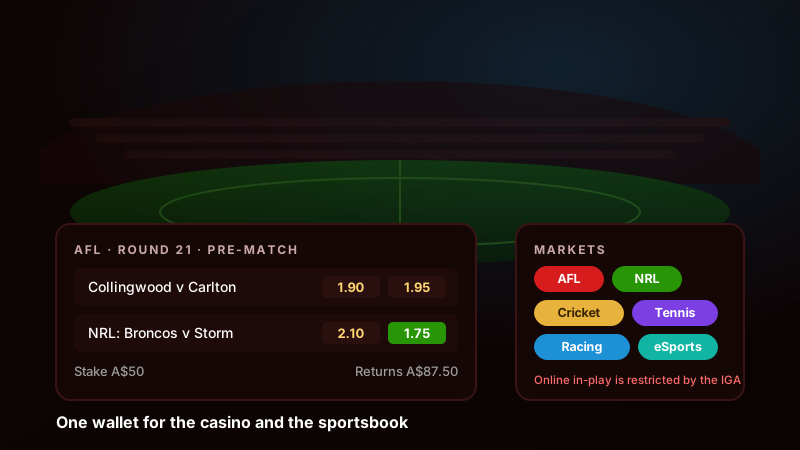
What is actually known about a TCL99 sportsbook
Three things need separating here, and most pages on this subject blur all three together. There is what the affiliate pages claim. There is what the reachable platform shows. And there is the large space in between, where nobody has confirmed anything either way and the honest word is simply “unknown”.
What the affiliate pages claim
A cluster of TCL99-branded sites carry betting content. One of them runs a dedicated betting page with a headline about sports betting and lists eSports in its navigation. Another puts the sports list at AFL, NRL, cricket, A-League, tennis and rugby and totals it as “20-plus sports”. One of them names the sportsbook supplier as “KickerTeck”, a platform name that does not appear in any provider directory, any licensing register, or on any other operator’s site.
Those pages are not the operator, and they contradict each other on facts that ought to be trivially checkable. The welcome offer is quoted as A$500 on one page and A$1,000 on another, with the free-spin count landing on 25, 100 or 200 depending which page you open, and in one case the same page gives two different figures in two different blocks. The game count ranges from “over 1,300” to “7,000-plus titles”. A licence number cited on one of them belongs, according to the regulator’s own register, to a different operator entirely.
That does not make the sports claims false. It means they carry the same evidential weight as the bonus figures: one webmaster’s assertion, sometimes copied sideways into three other sites and thereby made to look like corroboration. A single unverified source repeated five times is still a single unverified source.
What the reachable platform shows
The TCL99 platform that responds, accepts registration and runs a cashier presents itself as a casino and nothing else. Its navigation is built around game categories and game studios, with deposit, withdrawal and a VIP tier alongside them. The studios it fronts are the ones you would expect on a South and South-East Asian platform rather than an Australian-facing one, and independent traces point at Bangladesh as the brand’s home market, with the Australian positioning layered on afterwards by third-party sites chasing English-language search traffic.
There are innocent explanations for a missing sports tab: a sportsbook can sit behind a login, be gated by the account’s detected region, or be served on a different skin of the same platform. There are also less innocent ones, including a marketing claim nobody ever built. From the outside those possibilities look identical, which is exactly why the next section exists.
What follows from that, practically
If sport is the reason you are considering an account, do not plan around a product nobody has demonstrated: confirm it first, with your own eyes and the operator’s own support channel, and treat marketing copy arriving in place of a written answer as no answer. The wider situation applies too. The operator holds no Australian licence, its ownership is not publicly identified in any register we could find, and two independent review platforms rate it at the bottom of their scales. If you proceed anyway, the sensible posture is a small balance and withdrawals taken rather than left parked.
How to check whether an operator really has a sportsbook
This takes about ten minutes and it works on any operator, not just this one. Do it before your first deposit, not after, because after a deposit your leverage is gone and your money is inside somebody else’s system.
Look inside the account, not at the landing page
Landing pages are written by marketers, and in this corner of the industry frequently by people with no connection to the operator at all. The only interface that counts is the one you see after registering and logging in, which every operator allows you to do without depositing. Read the navigation top to bottom on both desktop and mobile. On a phone the sports rail is often a horizontal scroller of icons that hides everything past the sixth entry behind a swipe, so scroll it sideways before concluding anything.
If a sports section is there, go three levels deep: sport, then competition, then a single fixture. A real book shows a fixture list with prices attached. A stub shows a category that opens onto nothing, an empty board, or a redirect back into the casino lobby.
Ask support before you deposit, and get it in writing
Open the live chat and ask four questions in one message, so you get one answer instead of four evasions. Does the account include a sportsbook for Australian customers. Which sports and competitions are carried. Do sports bets count towards the wagering requirement on the welcome bonus, and at what percentage. Are there withdrawal conditions that apply to sports turnover specifically.
Save the transcript, by email if the widget offers it and by screenshot if it does not. A support agent’s answer is not a legal guarantee, but it is the difference between a dispute where you have something to show and one where you have nothing. If the replies are vague, deflected, or pasted marketing copy, treat that as the answer.
Read the bonus terms for the word “sportsbook”
Terms and conditions are dull and they are also the only document on the site that the operator has to live with. Search the page for “sport”, “sportsbook” and “betting”. An operator that genuinely runs a book will have clauses about it: contribution rates, maximum stakes while a bonus is active, void conditions on arbitrage-style betting. An operator that only has a casino will have terms that never mention sport at all, no matter what the front page says.
Test the smallest thing that can fail
If everything above checks out and you decide to go ahead, make the first deposit the minimum the site accepts, place one small bet on a mainstream market, and then withdraw whatever is left before you do anything else. You are not testing whether you can win. You are testing whether the money comes back, how long the cashier actually takes, and whether verification requests appear at withdrawal rather than at deposit. That single cycle tells you more about an operator than any review, including this one.
Know what a missing answer is worth
If the sports section is not there, or support cannot say plainly that it exists, the correct conclusion is not “it is probably hidden somewhere”. It is that the operator does not have the product you came for, and that you should spend your deposit somewhere that does. Australia has a large field of licensed bookmakers competing hard for exactly this turnover, and the cost of walking away from one signup is zero.
The Australian betting year, sport by sport
An Australian betting year has a shape to it, and understanding that shape is worth more than any operator-specific detail. Winter belongs to the two football codes. Summer belongs to cricket and tennis. Racing runs the whole way through and spikes violently for three weeks in spring. The table below maps that year with the market and bet types you will meet at Australian books generally. Read the last column as your own checklist rather than as a description of anyone’s product: two operators can both advertise “AFL betting” and offer wildly different things behind the phrase, and the only way to tell which you are looking at is to open a fixture and count the markets.
| Sport | Season window (AU) | Typical markets | Bet types | What to check in any book |
|---|---|---|---|---|
| AFL | March to August home-and-away, finals through September | Match result, line, total points, quarter and half markets, goalscorers, margin bands, premiership | Head-to-head, line, totals, multi, futures | Whether a fixture carries more than the core three markets, and how fat the first-goalscorer overround is |
| NRL | March to early October, State of Origin across May to July | Match result, line, total points, first and anytime try scorer, winning margin, premiership | Head-to-head, line, totals, multi, futures | Whether Origin fixtures get extra markets, and whether the line moves with late team news |
| Cricket (BBL) | December to late January | Match winner, innings totals, top team batter and bowler, total match sixes, player of the match | Head-to-head, totals, multi, futures | Whether player markets are offered at all, and when the board goes up relative to the toss |
| Cricket (Tests and internationals) | November to February at home, tours year-round | Three-way match result including the draw, series winner, session and day markets, top runscorer | Three-way head-to-head, totals, multi, futures | How the draw is priced, since a three-way market is where margin is easiest to hide |
| A-League | October to May, finals series into June | Three-way match result, both teams to score, total goals, correct score, championship | Three-way head-to-head, line, totals, multi, futures | Whether the local league gets the same market list as the European fixtures on the same board |
| Tennis | Year-round, Australian Open across the second half of January | Match winner, set betting, total games, game handicap, tournament outright | Head-to-head, line, totals, multi, futures | Whether coverage extends past the main draws into qualifying and challenger events |
| Horse racing | Year-round, Spring Carnival September to November | Fixed-odds win and place on metropolitan meetings, feature race outrights | Win, place, each-way, futures | Whether exotics and any tote comparison exist at all, and what the protest and scratching rules say |
| Rugby union | February to June for Super Rugby, spring internationals | Match result, line, total points, tournament outright | Head-to-head, line, totals, multi, futures | Whether anything beyond the headline three markets is offered |
| Basketball | NBL October to March, NBA October to June | Match result, line, total points, quarter markets, player points | Head-to-head, line, totals, multi | Whether the NBL is covered to the same depth as the NBA or treated as an afterthought |
| eSports | Year-round, clustered around majors from August to November | Match winner, map handicap, total maps, correct series score | Head-to-head, line, totals, multi | Compare a two-way eSports price against a mainstream one, because the margin gap is the price of the novelty |
One caution that applies everywhere and doubly at an offshore book. Sports lists on landing pages, sports lists in third-party reviews and the list actually rendering inside a book routinely fail to match, and the differences are not small. Competitions appear seasonally, markets get pulled without notice, and a sport carrying twenty markets in August may carry six in October. Treat any published list as a shape and read the live market list for the fixture you actually want before you plan anything around it.
AFL: how the markets work
Australian rules is the country’s biggest betting sport by volume for half the year. Eighteen clubs play a twenty-three round home-and-away season from March, then a four-week finals series in September involving the top eight, finishing with a grand final at the MCG. Any book taking Australian money carries the core three markets on every fixture; the interesting question is what sits behind them.
Head-to-head, line and totals in AFL
The head-to-head is priced tightest, because it takes the most money and is the easiest market to be publicly wrong about. The line sits at whatever handicap brings both sides back towards even money, and in AFL that number is large by the standards of other codes: handicaps of eighteen and a half or twenty-four and a half points are ordinary, and sixty-point blowouts happen often enough that the line is a genuinely different bet from the head-to-head rather than a variation on it.
Totals sit high because both sides regularly post scores in the eighties, so combined-score lines in the 150s to 170s are the normal range across Australian books. That number moves hard in wet weather and at the smaller grounds, and it tends to move before the price does, which is the one place a punter watching a Friday-night forecast has something resembling an edge over a board priced on schedule.
Goalscorer and margin markets
Anytime goalscorer prices cluster where you would expect, with a key forward short and a mid-rotation player out past 3.00. First goalscorer is a far fatter market for the book, being effectively a lottery among twenty-two players priced with an overround that would be indefensible on a head-to-head. Margin bands, where you pick a winning bracket rather than a winner, work the same way. They are entertaining and expensive, and they belong to small stakes rather than to a staking plan.
NRL: the other winter code
Rugby league runs a similar calendar to the AFL, from March to early October, with one structural difference that changes how you bet it. NRL scores are lower and margins tighter, so lines sit around six and a half points rather than eighteen and a half, and totals sit around 40.5 rather than 165.5. That compression pulls the line and the head-to-head much closer together than they are in AFL, and it means a single late try flips more bets in league than in any other code on the board.
State of Origin
The three Origin matches between May and July are the busiest nights of the league year, and books respond to that. Depth expands for those fixtures across first try scorer, man of the match, winning margin, series result and series correct score, where an ordinary round might carry a fraction of that list. The prices tighten as well, because volume forces them to. If you bet league three times a year, those are the three fixtures where you are closest to a fair price.
Futures and the premiership market
Premiership outrights open in February and stay up all year, drifting and shortening as the season resolves. A futures bet ties up your stake for months, which is worth pricing in rather than treating as free. At an offshore book that matters more than it would elsewhere: a stake in a market settling in October is a stake you cannot reach for seven months, held by a company you cannot complain about to anybody with authority over it.
Cricket: the BBL, the Test summer and the internationals
Cricket is the summer anchor. The Big Bash runs from December into late January with eight teams, and the T20 format hands a book a two-hour event with a clean binary result, which is why BBL market lists tend to be tidy: match winner, innings totals, top batter and bowler for each side, total match sixes, player of the match.
Why Test cricket is priced differently
Test matches carry three outcomes rather than two, because a draw is a real result across five days. That third leg changes the arithmetic of the market completely. On a two-way market a book has to balance two prices; on a three-way it has three, and the margin it can bury in the draw price is both larger and much harder for a casual punter to spot. Any Test market where the draw looks generously priced is an invitation to do the sums rather than a bargain, and the sums are in the margin section below.
Sessions, days and the parts you cannot bet online
The genuinely interesting cricket markets, top runscorer in a session, runs in the next ten overs, method of the next dismissal, are in-play markets by definition. They exist because a cricket match is a five-day rolling event with natural breakpoints. They are also exactly the category that Australian law puts out of reach online, which is the subject of a full section below and the single most consequential rule on this page.
Tennis and the Australian Open
Tennis is a year-round sport with one enormous local spike: the Australian Open across the second half of January at Melbourne Park. Depth in almost every book follows prestige closely. A Grand Slam main-draw match will carry match winner, set betting, total games, game handicap and correct set score. A qualifying match or a challenger event might carry the match winner and nothing else, and some books do not price them at all.
Two-way markets with no draw make tennis the cleanest sport for learning how margin works, which is why it appears in the worked example further down. It is also the sport where in-play betting would change a punter’s behaviour most, since a favourite dropping the first set is the classic live scenario, and it is precisely the scenario Australian law removes from the online book.
Horse racing and the Melbourne Cup
Racing is where an offshore book most obviously is not an Australian corporate bookmaker, and where you should check hardest before assuming anything. Australian punters treat a particular package as standard: fixed odds alongside tote pricing, best-of-the-best or top-fluctuation options, clearly written protest and scratching rules, and the exotics, meaning quinella, exacta, trifecta and first four. Offshore books frequently carry fixed-odds win and place only, and rarely spell out what happens when a horse is scratched after you have bet or a placing is overturned by the stewards.
The Melbourne Cup runs on the first Tuesday in November, which in 2026 falls on 3 November, over 3,200 metres at Flemington, and it is the one race of the year where people who never bet place a bet. Outright markets for the Cup, the Caulfield Cup, the Cox Plate and The Everest open weeks ahead during the Spring Carnival. If racing is your main sport, take the exotics question seriously before you sign up anywhere: a fixed-odds win price with no exotics and no tote comparison is a narrow way to play a Cup carnival, and no bonus makes up for it.
eSports
eSports betting in Australia covers Counter-Strike 2, Dota 2, League of Legends, Valorant and Rainbow Six at most books that offer it, and the board lives and dies by the tournament calendar. During a major you get a full fixture list with match winner, map handicap, total maps and correct series score. Between majors you might find four matches on the entire board.
Prices in eSports carry a noticeably wider margin than AFL or tennis, which is an industry-wide pattern rather than a quirk of any one operator. Smaller markets, less liquidity and fewer sharp punters mean a book protects itself with a fatter overround. If you bet eSports, do it because you know the teams and the patch, not because you think the prices are good, because they are not.
Open TCL99 and check what is actually listed in the accountBet types, in plain language
Five bet types cover almost everything you will ever place. The names shift slightly between books and countries, so here is what each one means in the Australian context and, more importantly, what each one costs you.
Head-to-head
Pick the winner. In AFL, NRL, tennis, basketball and T20 cricket there are two outcomes and no draw provision, so one of your two options wins. In football and Test cricket there are three, because a draw pays out as its own result. This is the market with the tightest pricing in every sport, for the simple reason that it takes the most money and is the easiest for a book to get publicly wrong.
Line, also called handicap or spread
The book gives one side a head start in points and prices both sides near even money. An AFL line of minus 18.5 means your team must win by nineteen points or more. The half-point exists so the bet cannot end level and be refunded. Line betting is how you back a strong favourite at a usable price instead of taking 1.20, and how you back an outsider you expect to lose respectably rather than to win.
Totals, also called over/under
You bet on the combined score of both sides rather than on who wins. Over 165.5 points in an AFL match, under 40.5 in an NRL match, over 22.5 games in a tennis match. Totals reward people who watch conditions rather than form: weather, ground size, an injured key defender, a pitch that has already produced two low-scoring games this week. They are also the market where a stale line survives longest, because the public bets winners rather than totals.
Multis
Several selections combined into one bet, where every leg must win or the whole thing loses. The odds multiply, which is why a four-leg multi of four selections at 1.90 pays about 13.03 rather than 1.90. So does the margin, which is the part the marketing never mentions and which is worked through below.
Futures
Long-term markets settled at the end of a season or tournament: the premiership, the Brownlow, the Dally M, the BBL title, the Australian Open outright. Your stake is locked up for the duration. The prices look generous because the field is large, and because the book is holding your money for months while it waits.
Reading decimal odds and finding the bookmaker’s margin
Decimal odds are the easiest format in the world to read and the easiest to misread. The number is your total return per dollar staked, stake included. It is not your profit. At 1.90 a winning A$100 bet gives you back A$190, of which A$90 is new money. Somebody who reads 1.90 as A$190 profit has misjudged the bet by more than half, and that misreading is common enough that it is worth stating plainly before anything else.
Decimal odds already include your stake: at 1.90 a winning A$100 bet returns A$190, of which A$90 is profit.
If you learned betting on fractional prices, the translation is simple: 1.90 is 10/11, 2.00 is evens, 3.00 is 2/1 and 1.20 is 1/5. Subtract one from the decimal and you have the fractional value as a share of your stake. Decimal is the Australian standard and most books here offer no format switcher.
Turning a price into a probability
Divide one by the decimal odds and you get the probability the market implies. At 1.90 that is 0.526, or 52.6 per cent. At 2.50 it is 40 per cent. At 4.00 it is 25 per cent. At 1.20 it is 83.3 per cent. This single division is most of the skill of reading a betting market, because it converts a number designed to look like a prize into a number you can argue with.
The argument is the point. If you think a side wins more often than 52.6 per cent of the time, 1.90 is worth taking; if you do not, it is not, however much you like the team. Every bet is a claim that the market has mispriced something, and until you have converted the price to a probability you have not made that claim, you have only picked a name.
Working out the overround on a real market
Now add both sides of a market together. A typical AFL head-to-head sits at something like 1.90 and 1.95. One divided by 1.90 is 0.526. One divided by 1.95 is 0.513. Add them and you get 1.039, or 103.9 per cent. Probability cannot exceed 100 per cent, so that extra 3.9 per cent is the bookmaker’s margin, built into the prices before a ball is kicked. Expressed as a share of everything staked on the market it works out at about 3.8 per cent, and that figure is the house edge of sports betting in the same way that a return-to-player figure is the house edge of a pokie.
Run the same sum across other markets and the picture sharpens. A tennis match at 1.28 and 3.75 gives 0.781 plus 0.267, or 104.8 per cent, so nearly five per cent. A three-way football market at 2.30, 3.40 and 3.10 gives 0.435 plus 0.294 plus 0.323, which is 105.2 per cent. An eSports match at a minor tournament can push past 108 per cent. Those numbers are indicative of what markets in each sport typically look like rather than quotes from any particular book on any particular day, but the ranking holds everywhere: the more liquid the market, the thinner the margin, and the more obscure the market, the more it costs you to be right.
This is also the only genuinely reliable way to compare two operators. Ignore the bonus and the interface, take the same fixture at both books, add the implied probabilities and compare the totals. The book with the lower percentage charges you less to place the same opinion, on every bet. That comparison takes thirty seconds and outperforms every review-site rating, including this one.
Why multis are where the margin hides
Here is the arithmetic that matters most and gets explained least. Margin compounds across legs. If each leg of your multi carries that same 3.9 per cent overround, a four-leg multi carries roughly 1.039 to the fourth power, which is about 16.6 per cent. You have taken a bet with a house edge under four per cent and turned it into one with a house edge in the mid-teens, in exchange for a bigger headline number on the slip. At eight legs the compounding puts it above 36 per cent, which is worse than most casino games on the same site.
That does not make multis irrational. A small stake at long odds is a legitimate way to buy a Saturday’s worth of interest, and people who understand exactly what they are paying for are entitled to pay for it. It does mean nobody should treat a multi as a serious method of making money, and it means the staking systems that circulate in betting forums, doubling after a loss, chasing a losing multi with a larger one, cannot beat an edge baked into the prices themselves. There is no sequence of stakes that converts a negative expectation into a positive one. The margin is the product.
In-play betting and the Interactive Gambling Act 2001
This is the part of the subject most pages skip or garble, so it is worth being precise about. The Interactive Gambling Act 2001 is federal law, and it prohibits the provision of online in-play betting on a sporting event to customers physically located in Australia. Once an event has started, an operator cannot lawfully accept your bet on it through a website or an app. Bets placed before the event starts are fine, and that is the whole of Australian online sports betting: a pre-match product, by design and by statute rather than by choice.
Two things about that sentence matter to you as a reader. The prohibition is addressed to the operator, not to the punter. The Act creates obligations and civil penalties for the people providing the service, and it contains no offence for the person placing the bet. Enforcement sits with the Australian Communications and Media Authority, which investigates complaints, pursues operators, and asks internet providers to block sites that keep offering prohibited services to Australians. Nobody is coming after a punter for clicking a live price, and any page that implies otherwise has misread the statute.
Where pre-match ends and in-play begins
The line is the start of play, and it is more literal than people expect. First bounce in AFL. Kick-off in NRL. First ball in a cricket match. First serve in a tennis match. A bet accepted a minute before the first bounce is a pre-match bet; a bet accepted a minute after it is an in-play bet, even if nothing has happened yet and the scoreboard still reads nil-all.
For multi-part contests the unit is the individual match, not the tournament. A Test series runs for weeks, but each Test is its own event and each day’s play sits inside it. An Australian Open outright can be backed at any point during the fortnight, because the tournament is the event and it has not resolved, while a third-round match starting at 11am is closed to online betting from the moment the first serve goes in. This is also why the cricket markets that look most attractive, next-over runs, method of dismissal, session totals, are the ones you cannot place online from Australia at all: they only come into existence once play has started.
Why Australian bookmakers take live bets over the phone
Ring an Australian corporate bookmaker during a match and you can place a live bet, because the Act carves out bets placed by voice call and bets placed in person at a venue. Only the online channel is closed. That is why the large Australian books run staffed phone lines through a Saturday afternoon, and why live betting there feels like 1998: you speak to a person, you are read a price, you accept or decline, and the price you get is the one confirmed on the call rather than the one you saw on a screen.
The obvious workaround was tried and closed. Around 2015 several bookmakers launched click-to-call features, in which the app placed a nominal phone call so that a live bet placed with a thumb technically counted as a bet by telephone. Parliament shut that down in 2017. Voice means voice, and a synthetic call inside an app is not it.
How the rule looks at an offshore book
Now the practical part, and it applies to any offshore operator you might use. Such a book does not hold an Australian licence and sits outside the system the Act polices day to day, so a live tab may simply be present in the interface, showing prices on a match already under way. Seeing it does not mean the restriction has been lifted or that it does not apply to you. It means the operator is not observing it.
What follows from that is worth thinking through before you place anything. An operator ignoring one Australian rule is not a promising signal about how it handles the rules you actually care about, such as when it pays you. There is no Australian regulator to escalate a disputed live settlement to, no ombudsman, and no enforceable path if a bet is voided after the fact. And because internet providers can be asked to block a site that keeps offering prohibited services here, an offshore book can become unreachable from an Australian connection with no notice, which is a strong argument for keeping your balance small and withdrawing rather than leaving funds parked between weekends. None of this creates a legal problem for you as a punter. It creates a practical one, and the practical one is the whole story.
Check what TCL99 lists before you depositOne wallet, and what a sports bet does to a casino bonus
Casino-first operators normally run a single balance rather than separate casino and sportsbook wallets, and where that is so it is a genuine convenience: deposited money is available across pokies, live tables and any sportsbook without internal transfers. Win on the football on Saturday and the funds are there that night if you want to sit down at live baccarat and roulette. The money side then works as it does for the casino: same minimum, same methods, same withdrawal rules, same verification. Sources quoting a TCL99 minimum deposit put it around A$20, they disagree on the withdrawal minimum, and their payment-method lists contradict each other badly enough that the only reliable list is the one in your own cashier. If you are starting from zero, add funds to bet on sport with a method the cashier itself confirms rather than one a landing page advertises.
The bonus trap, and it is a real one
Welcome offers at casino-first operators are casino bonuses. The published TCL99 figures vary by source, so no single number should be quoted as the offer, but the structure does not depend on the number: a deposit match with a wagering multiple attached and a clearing window measured in days. What no source publishes, for this operator or most in the same bracket, is the contribution rate for sports betting against that wagering requirement.
In this corner of the industry the answer is almost always zero. Casino bonuses clear on casino games, sportsbook turnover counts for nothing, and in a shared-wallet system a sports bet placed while bonus funds are active can do worse than not count: it can breach the terms and void the bonus along with anything won from it. Until the terms inside your own account say otherwise in writing, treat sport and bonus as two things that must not overlap. Clear the bonus first, or decline it and bet with cash. If you would rather use the bonus as intended, switch between sport and pokies deliberately, with the wagering finished before you open a betslip.
Betting from a phone
There is no legitimate native TCL99 app, and third-party sites offering an APK under that name have been flagged as fake by reviewers, including one of the affiliate sites promoting the brand. Off-store APK files are a standard malware vector and there is no reason to take that risk for a browser product. What the sources describe instead is a mobile site with an optional add-to-home-screen shortcut.
Betting in a mobile browser works fine, with one habit worth building: place bets a few minutes early rather than in the ninety seconds before the start. A slow connection at the wrong moment turns a pre-match bet into a rejected one, and once the event has started the online market is closed to you by law whichever book you use. Our walkthrough of how to bet on sport from the app covers the home-screen shortcut and what to avoid installing.
How we would approach this one
The honest summary is short. TCL99 is a casino brand whose Australian presence is built almost entirely by third-party marketing sites, and the sportsbook those sites describe has not been demonstrated on the platform anyone can actually reach. That is not the same as saying it does not exist, and it is a very long way from saying it is worth building a betting season around.
If you already hold an account here for the casino, log in and look, ask support, and keep the answers. If sport is the reason you are signing up at all, verify before depositing rather than after. And whatever you conclude, the betting knowledge on this page transfers: decimal odds, implied probability, overround, compounding margin on multis and the in-play rule apply identically at every book you will ever use in this country.
What holds up
- Decimal odds are the Australian standard, and every price is a total return per dollar staked with the stake included
- The Australian sporting calendar gives a full betting year: AFL and NRL through winter, cricket and tennis through summer, racing all year
- A bookmaker's margin can be calculated from the prices themselves with one division per selection, and used to compare any two books
- The Interactive Gambling Act addresses operators, not punters, and creates no offence for the person placing a bet
- Pre-match online betting is lawful and unrestricted, which is where the large majority of Australian turnover sits
- A single casino-style wallet, where an operator runs one, means no internal transfers between products
- Whether any sportsbook exists can be settled in ten minutes by registering, reading the navigation and asking support in writing
What is not confirmed
- No sports section appears in the navigation of the TCL99 platform that can actually be reached
- Every mention of a TCL99 sportsbook comes from affiliate landing pages rather than from the operator
- The sports list, the market depth and the named betting platform each rest on a single uncorroborated source
- Online in-play is restricted by law, so a live tab at an offshore book is not something to build a strategy on
- No source publishes a contribution rate for sports turnover against casino bonus wagering
- Published welcome-bonus figures contradict each other across sources, so no single number can be quoted as the offer
- The operator is offshore with no Australian licence, so there is no local regulator to escalate a disputed settlement to
Two habits will save you more money than any tip. Do the one-divided-by-the-odds sum before you back anything, so you know which probability you are being asked to accept and can decide whether you disagree with it. And keep your balance at the level you intend to bet with this weekend rather than this season, because at an offshore operator the money sitting in your account is the part you have the least control over. Everything else on this page is detail; those two are the discipline. If something in the mechanics is still unclear, we have the common questions and what the sportsbook covers in one place.
Before you open a betslip anywhere
A TCL99 sportsbook is claimed by affiliate pages and does not appear in the navigation of the platform that can be reached, so check for it inside your own account and ask support in writing before you deposit anything. Whichever book you end up using, Australian odds are decimal, the margin is built into the price, and online in-play betting is restricted by federal law. Read the terms in your own account first.
Open TCL99 and check for yourself