TCL99 Login: Access Your Account and Fix Sign-In Problems
Signing in should be the dullest thirty seconds of your evening. Most of the time it is: you type an email, you type a password, the balance appears, and you get on with it. The trouble is that when it does not work, the site tells you almost nothing useful. A single grey line saying the details are incorrect covers at least four completely different problems, and none of them are fixed the same way.
Signing in behaves differently on a desktop, on an Android phone, on an iPhone, on a borrowed laptop and behind a VPN, and every one of those differences has a documented cause rather than a mysterious one. What follows works through them one at a time, drawn from the operator’s published account terms and from the patterns that run through the support threads and player reports we read while researching the brand. If you are still deciding whether an account is worth having at all, start with whether is TCL99 worth playing and come back here once you have one.
A warning about the figures before the detail. The published terms for this operator do not agree with each other across sources: the idle timeout, the number of failed attempts before a lock, and the review window on a flagged account are all quoted differently depending on which write-up you read. The numbers on this page are the ones that recur most consistently across those sources through 2026. Treat them as a working guide and check the terms inside your own account, because those are the ones that will actually be applied to you.
- 1Open the site and press Login
The Login button sits in the top-right of the header on desktop and inside the account menu on mobile. It opens an overlay rather than a new page, so you keep whatever you were reading.
- 2Enter email and password
Use the email address you registered with, not an alias that forwards to it. The password field is case-sensitive and has no visible strength meter at this stage, only a small eye icon to reveal what you typed.
- 3Complete any verification step
If the site has seen unusual activity — a new device, a new network, or several failed attempts — it adds a captcha or emails you a confirmation link before the session opens.
- 4Land in the cashier or lobby
A successful sign-in drops you back where you started with your balance in the header. If you came from a deposit link you land straight in the cashier instead.
Signing in from a computer
The desktop flow is the one that breaks least often, mostly because a full keyboard makes password typos less likely and because desktop browsers handle cookies more predictably than mobile ones do. The Login control sits in the header on every page of the site, so you never need to hunt for a dedicated sign-in URL, and you should not go looking for one either, for reasons covered further down.
The form, field by field
Two fields, nothing else. The email box does not accept your username or your account number, because neither exists here: your email address is your login identity. If you registered with a Gmail address and later set up an alias or a forwarding rule at a different domain, the alias will not sign you in. The system matches the exact string it stored when you opened the account.
The password field is case-sensitive from the first character to the last, and there is no forgiveness for a trailing space. That last one catches more people than you would expect: if you copy a password out of a note or an email, the selection often picks up a space at the end, and the site treats that as a different password. Paste it, then press End and check the cursor sits flush against the final character.
There is no two-factor option at TCL99. No authenticator app, no SMS code on every sign-in, no hardware key. That changes the weight your password has to carry, which is why it matters: it is the only thing between an outsider and your balance, so the advice further down about password managers is not a formality. If you have not opened an account yet, you can sign up for a new account and set that password properly the first time rather than fixing it later.
Staying signed in, and why we would not
The overlay carries a checkbox that keeps the session alive between visits. On a machine only you use, that is a reasonable convenience. On anything shared, whether that is a family desktop, a work laptop or a machine in a share house, it means the next person to open the browser is inside your account with your money in it, and there is no second factor to stop them. Left unticked, an idle session here lasts around half an hour before it drops you, which is typical behaviour for platforms of this type: short enough to be genuinely protective and long enough not to be annoying while you play.
Signing in from a phone
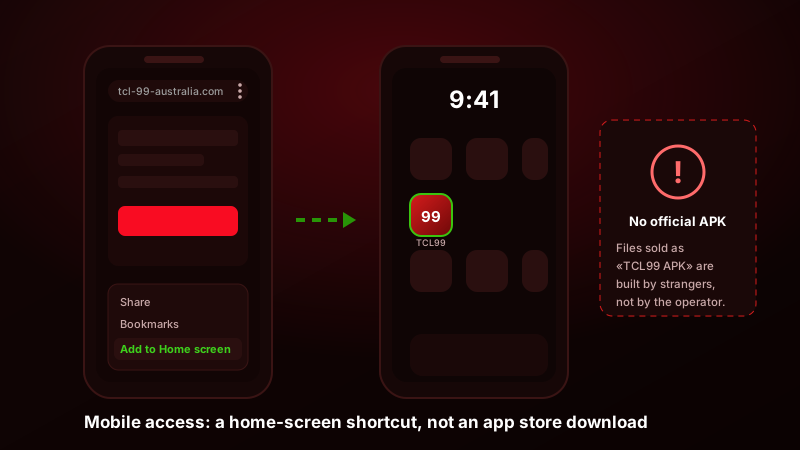
Mobile is where most Australian players actually log in, and it is also where most of the odd behaviour lives. There is no native app to install, no APK and nothing in the Play Store or the App Store, so everything happens inside the mobile browser. Anything advertising itself as a downloadable TCL99 app is not from the operator, and you should treat the file the same way you would treat any executable from a stranger.
Android and Chrome
Chrome on Android handles the sign-in overlay cleanly. The one thing that trips people is the autofill prompt: Chrome offers to save the password, you dismiss it because you are in a hurry, and then on the next visit it fills the email but leaves the password blank, which reads on screen as though the site has forgotten you. It has not; the browser simply never stored the second half. Let it save, or store the pair in a proper password manager instead.
Data Saver and aggressive ad-blocking extensions can also strip the captcha frame out of the page. When that happens you do not get an error. You get a form that submits and then does nothing, over and over. Turn the blocker off for the site and the captcha reappears.
iPhone and Safari
Safari’s Prevent Cross-Site Tracking setting is on by default and occasionally clears the session cookie between visits, which shows up as being logged out every single time even though you ticked the remember box. It is not a fault in the site and there is nothing support can do about it. The practical fix is to add the site to your home screen, which gives the session its own storage and holds it far more reliably. The full walk-through for that lives on the page where we open the site on your phone and pin it, with the Android steps alongside.
Private browsing and the vanishing session
If you sign in through a private or incognito window, the session dies the moment you close the tab. That is the whole point of private browsing, but people forget they are in it — particularly on iPhone, where the private tab group looks almost identical to the normal one. If you are being logged out constantly on one device and never on another, check which tab group you are actually in before you blame the operator.
Resetting your password step by step
There is one recovery path and it runs through your email. No security questions, no SMS fallback, and no support agent who can read your password back to you. They cannot do it, and anyone claiming otherwise is not from the operator.
Open the Login overlay and press the Forgot password link under the password field. Enter the email address on the account and submit. The site responds with the same neutral confirmation whether or not that address exists, which is standard practice and means the screen cannot tell you if you got the address wrong. Check the inbox for a message containing a reset link. Open the link, set a new password twice, and you are returned to the login form to sign in with the new one.
What the reset link does and does not do
The link is single-use and short-lived. Reset tokens of this kind are good comfortably inside the hour and dead well before the next morning. If you request three resets in a row because nothing seems to be happening, only the newest link functions. The earlier two are invalidated the moment the next request goes out, which is exactly why people end up clicking the first email in the list and getting an expired-token page.
Resetting a password does not unlock a locked account, does not clear a review flag, and does not release a withdrawal that is sitting in the queue. Those are separate states with separate causes, and the reset flow is blind to all of them. If you could not sign in because of a lock, you will still not be able to sign in after the reset succeeds.
Choosing the replacement
The form wants at least eight characters with mixed case and a digit. Meet it and move on — but do not reuse the password from your email account, because that pairing is the single worst combination possible. Whoever holds your email password holds the reset link too, and at that point the casino password is decorative.
When the reset email does not arrive
This is the most common dead end, and across the reports we went through it is almost never the operator’s mail server. Work through these in order rather than firing off four reset requests.
Spam, promotions and quarantine
Gambling-adjacent mail is filtered hard. Check the junk folder, and on Gmail check the Promotions and Updates tabs as well. The reset message is transactional, but the sending domain often carries a promotional reputation, which is enough to sort it sideways. On a corporate or school address there may be a quarantine you never see at all, holding the message until an administrator releases it. If you registered with a work address, that alone can explain months of silence.
The address you actually registered with
People misremember which of their addresses they used, especially if they have both a personal and a shared household inbox. A single-character typo at registration is worse still: the account exists under an address that does not, so no reset will ever land anywhere you can read. Neither problem produces an error message, because the site deliberately does not confirm whether an address is on file. If you have two plausible addresses, request a reset for both and see which inbox lights up.
Provider-side delay
Some Australian ISP mailboxes queue mail from offshore senders for several minutes during busy evening hours. Transactional mail of this kind lands within about five minutes on a quiet weekday afternoon and closer to twelve on a Saturday night. Give it a quarter of an hour before you decide it is lost, and do not request another link during that window or you will kill the one that is already in flight.
Unconfirmed from the start
If you never clicked the confirmation link when you first registered, the address on the account is unverified, and some flows will not send to an unverified address at all. In that case the reset is not the problem at all. The registration is unfinished, and support has to finish it for you.
Login errors and what they actually mean
Here is the translation table. The left column is what you see, the middle column is what is happening underneath, and the right column is the action that resolves it.
| Error message or symptom | What is actually happening | What to do |
|---|---|---|
| Invalid email or password | Deliberately vague. Covers a wrong password, a wrong address, a trailing space in a pasted string, and caps lock. The site will not tell you which, so that outsiders cannot use the form to discover which addresses have accounts. | Retype the password by hand once, watching the caps lock key. If that fails, request a reset rather than guessing again, since guesses are what trigger the lockout. |
| Your account has been temporarily locked | Too many failed attempts in a short window. It is an automatic brute-force defence, not a punishment, and it applies to the account rather than to your device. | Stop trying. Wait out the cooling-off period, which on platforms built like this one clears within the hour, then reset the password instead of attempting another guess. Switching browsers does not bypass it. |
| Account under review | Compliance has flagged something: a first large withdrawal, a mismatch between your name and your payment method, sign-ins from two countries in a day, or a routine periodic check. The credentials are fine; the account is paused. | Contact support, ask what document they need, and send exactly that. Do not open a second account while you wait, because that turns a pause into a closure. |
| Reset email never arrives | Filtered into spam or a quarantine, sent to a mistyped address, delayed by your provider, or blocked because the address was never confirmed at registration. | Check junk and the Gmail tabs, wait fifteen minutes, try any second address you might have used, then raise a ticket with the approximate registration date. |
| Signed out mid-session | Idle timeout at around half an hour, a switch between mobile data and Wi-Fi that changes your IP mid-session, or a browser clearing cookies on close. | Sign in again and, if it repeats on one device only, check for tracking prevention or a cookie-clearing setting on that browser. |
| Captcha loops forever | The challenge frame is being blocked by an ad blocker, a privacy extension, a strict DNS filter, or a data-saving proxy. The form submits, the challenge never validates, nothing happens. | Disable the blocker for this site, or open the sign-in in a clean browser profile. Clearing the site’s cookies also resets a stuck challenge. |
| Sign-in refused while on a VPN | Your traffic is arriving from a data-centre IP range, and those ranges are routinely scored as high-risk. The account may also be flagged for the country mismatch afterwards. | Turn the VPN off and sign in on your normal connection. Playing behind a VPN can breach the operator’s own terms, which is a fight you do not want when there is money in the balance. |
| Bookmark leads to a page that does not load or looks wrong | An old saved link to a domain that no longer belongs to the operator, or never did. Abandoned domains get bought and re-pointed, and the replacement often carries a convincing copy of the login form. | Delete the bookmark. Reach the site the way you first found it, check the address bar and the padlock, then re-bookmark from the page you are certain about. |
| Account closed for duplicate accounts | The one-account-per-person rule has been enforced. It usually happens when someone reopens rather than recovers, or when two people in the same household register from the same device and IP. | Write to support from the address on the original account and ask for that one to be reinstated. Do not create a third. |
| Please confirm your email address | The account exists but the registration was never finished, so the cashier and sometimes the whole session stay locked. | Request a new confirmation email from the account area, or ask support to resend it if the option is not visible to you. |
| Page loads but the header shows no balance | A cached copy of the logged-out page is being served to you, usually after a network switch or on a home-screen shortcut that kept an old page in memory. | Pull down to refresh, or force-reload. If it persists, clear the site data for the domain and sign in fresh. |
Which problems actually turn up most
Not every failure is equally likely, and knowing where to look first saves you a great deal of time. The split below reflects the pattern across the support threads and player reports we went through while researching this brand, where the overwhelming majority of failed sign-ins turn out to be ordinary credential problems rather than anything to do with the operator’s systems.
Distribution based on the support threads and player reports we reviewed, not on operator data.
The practical reading of that chart: before you write to anyone, reset your password and check your junk folder. Those two actions cover three-fifths of everything that goes wrong. Compliance reviews, the ones people worry about most, are the smallest slice, and they are also the only category where contacting support is the right first move rather than the last.
Account locked or suspended: causes and what to do
These are three different states that all look identical from the login form, and the response to each is different.
Locked after failed attempts
Automatic, temporary, and triggered by repeated wrong passwords. Nothing has been taken from you and no human has looked at your account. The wrong response is to keep trying from a different browser or a different device, because the counter is attached to the account rather than the session and you are simply extending the lock. Wait, then reset.
Under review
A human is involved here. Reviews are usually attached to money moving: a first withdrawal, an unusually large one, or a deposit method whose name does not match the account holder. They are the reason people find themselves locked out at exactly the wrong moment. If your review coincides with a pending payout, read our walk-through of cashing out your winnings, because most reviews resolve by supplying the verification documents you would have needed anyway.
Send what is asked for, in the format asked for, in one message. Four separate emails with one photo each will be read as four tickets and answered slowest. A clear photo of the whole document, corners visible, no glare, no cropping, beats a high-resolution close-up of half of it every time.
Closed for duplicates
One account per person, per household, per device, per payment method. The rule sounds harsh until you consider that its main purpose is stopping one person from claiming the welcome package five times. The trap is innocent: someone forgets their password, cannot be bothered with a reset, and registers again. Now there are two accounts, and the newer one is the one that gets closed, sometimes along with whatever is sitting in it. Recover the account you have instead of registering another.
How to write the message that gets answered
Write from the email address on the account. Give your account email, your approximate registration date, the exact wording of the message you are seeing, the device and browser, and what you have already tried. Attach the documents in the same message. Ask one specific question rather than describing your frustration. If you want a sense of what support answers quickly and what they do not, our fix a login issue section collects the questions that come up most and the answers that actually move things along.
Mirrors and alternative domains: why they are dangerous
Search for this brand’s login and you will find pages offering a working mirror, a backup address, or an alternative domain for when the main site is down. Do not use them, and we are not going to publish any such address here even to warn you off it, because naming them sends traffic to them.
What a cloned login page takes from you
A phishing clone is a copy of the real sign-in page hosted somewhere else. It looks right because it usually is right: the attacker has saved the operator’s own HTML and CSS. You type your email and password into a form that belongs to a stranger. The page then forwards you to the genuine site, where you sign in normally and notice nothing. Meanwhile your credentials are in someone else’s hands, and because there is no two-factor step on this brand, those credentials are all that is needed. The first sign is usually a withdrawal you did not request, going somewhere you have never seen.
Session theft is worse than password theft
Some clones do not want your password at all. They proxy the real site, let you sign in for real, and then steal the session cookie that gets issued afterwards. Changing your password does not evict someone holding a live session token; you have to end the sessions themselves. That is why the recovery sequence at the end of this page starts with signing out everywhere rather than with a new password.
Fake support and the fake unlock
The other mirror-adjacent scam is a support channel that is not one. Someone answering as staff on a messaging app or a forum will offer to unlock your account, speed up a review, or release a stuck payout, and will ask for your password or a code from your email to do it. Real support never needs your password, because they do not verify you that way. Anyone who asks is not staff, whatever the display name says.
Checking the address before you type anything
Read the domain in the address bar character by character, left to right, and stop at the first slash, because everything after it is decoration and can say anything at all. Look for extra words bolted on, hyphens where there were none, a swapped letter, or a different ending. The padlock only tells you the connection is encrypted; a phishing site can have one within minutes, so it proves nothing about who owns the page. Get to the site from your own bookmark or by typing the address yourself, never from a link in an email or a message, and never from an advertisement above the search results. For the wider question of who you are dealing with and what is actually verifiable about this operator, we set it out in the TCL99 licence and safety check.
Go to the TCL99 site and check today's termsAccount hygiene that actually matters here
With no second factor available, everything rests on the password and on where you use it. Four habits carry almost all the weight.
A password used nowhere else
Credential stuffing is the dominant attack on gambling accounts: someone takes a username and password leaked from an unrelated breach and tries the pair on hundreds of casino sites automatically. It works because people reuse passwords. If the password on your casino account is unique to it, that entire category of attack fails at the first attempt. Length matters more here than complexity: a passphrase of four unrelated words is stronger, and easier to type on a phone, than eight characters of punctuation.
Let a password manager hold it
A manager is not only about strength; it is about phishing resistance. A manager fills credentials only on the exact domain they were saved for. Land on a convincing clone and the manager stays silent, and that silence is the most reliable warning you will ever get, because it does not depend on you noticing a swapped letter at eleven at night. The one built into your browser is enough if you use nothing else.
Public Wi-Fi and shared networks
Airport, café, hotel, campus. Modern encryption means the network operator cannot read your password out of the traffic, so the old warnings are overstated. The shoulder next to you is real, though, captive portals do intercept traffic before you reach the site, and a network with a plausible name may not be the venue’s. If you must sign in, use mobile data instead. And do not sign in on public Wi-Fi through a VPN thinking you have solved it, because that combination is exactly what gets a sign-in refused and an account flagged.
Other people’s devices
If you sign in on someone else’s laptop, phone or a machine in a library, do three things before you stand up: decline the browser’s offer to save the password, use a private window so nothing is written to disk, and sign out properly from the account menu rather than just closing the tab. Closing a tab leaves the session alive. On your own devices, the same logic applies to anything you lend out: a phone handed to a child with the site pinned to the home screen is a live session in someone else’s hands.
Sign out on purpose
The idle timeout at around thirty minutes is a backstop, not a strategy. Sign out from the account menu when you finish a session, particularly after you have deposited or requested a payout, and particularly on mobile where the browser keeps tabs alive in the background for days.
If you think someone else has been in your account
Move quickly and in this order. The sequence matters, because doing it out of order leaves an intruder with a live session while you congratulate yourself on a new password.
One. Sign out of all sessions if the account area offers it. If it does not, change the password immediately, since on most platforms that invalidates other sessions as a side effect. Either way, do this before anything else.
Two. Change the password on your email account as well, and make it different from everything else you own. The email is the master key: whoever controls it controls the reset link, and locking the casino account while leaving the inbox open achieves nothing.
Three. Check the transaction history for deposits, withdrawals and any change of payment details. Screenshot everything before you contact anyone, with the dates and times visible, because the record is your evidence and you want it in your own hands.
Four. Write to support from the account’s own email address. State plainly that you believe the account has been accessed by someone else, list the transactions you do not recognise with dates and amounts, and ask them to freeze withdrawals while it is investigated. Asking for a freeze yourself is the step people skip, and it is the one that stops money leaving while the ticket sits in a queue.
Five. If a payment method was used without your say-so, tell your bank or card issuer the same day. Australian banks handle unauthorised transaction claims on their own timetable and it runs independently of anything the casino does.
Six. Once it is settled, work out how the credentials leaked. Nine times out of ten it is a reused password from an old breach or a login typed into a cloned page reached through a search advertisement. Fix the cause, or you will be back here.
Sign in the safe way, every time
Reach the site from your own bookmark, use a password that exists nowhere else, and sign out from the account menu when you are done. If you are locked out, reset before you retry — repeated guesses are what trigger the lock in the first place. Terms shown inside your own account are the ones that apply to you.
Sign in to TCL99The short version
Sign-in problems at TCL99 fall into a small number of buckets and almost all of them are yours to fix rather than the operator’s. Wrong credentials and unconfirmed email addresses account for the majority; a temporary lock after too many guesses is the second tier; browser settings, blockers and VPNs make up most of the rest. A compliance review is the one case where you cannot do anything except supply what is asked for and wait, and even then the wait shortens dramatically if you send complete documents in a single message.
Two rules are worth more than the rest combined. Never reach the login page through a link you did not create yourself, because the cost of typing your details into a clone is your whole balance and there is no second factor to save you. And never open a second account to escape a problem with the first, because the duplicate rule is enforced automatically and the newer account is always the one that loses. Recover the account you already have, verify it properly, and stay with it.