TCL99 Pokies: Slot Library, Providers and RTP
This guide works through the TCL99 pokies lobby, its paytables and its published terms as they stood in August 2026, across the stake range the lobby itself advertises from A$0.10 to A$2.00, and the first thing to get straight is that a slot library is a maths problem with pictures on top rather than a feature list. Everything below is written from that angle: what the return-to-player figure on each title actually promises, how long a real bankroll survives at a given stake, which games move the bonus wagering counter and which quietly do not, and where the numbers printed in the game disagree with the numbers printed on marketing pages. If you want the wider picture on the operator first, covering payouts, verification and the licence question, start with our TCL99 casino review summary and come back here for the games.
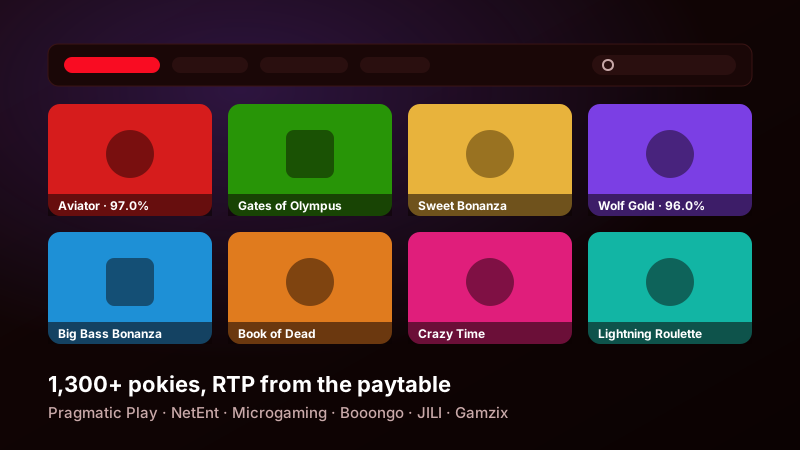
What is actually in the TCL99 pokies lobby
TCL99 lists 1,300-plus pokies. That number comes from the brand’s own landing pages, and it is the sort of figure every offshore casino rounds in its own favour, because a “game” can mean a distinct title or it can mean a regional variant of a title you already counted. What we can confirm by scrolling is that the catalogue is genuinely deep rather than a thin skin over one aggregator: the provider filter returns meaningful results for six separate studios, the search box finds titles by partial name, and the New and Popular rails refresh rather than sitting frozen for weeks.
How the catalogue is organised
The lobby splits into rails: Popular, New Releases, Jackpots, Bonus Buy, Crash and Instant, plus a provider grid. On desktop the filters sit as a left rail; on a phone they collapse into a dropdown above the tiles. Sorting is limited. You can filter by studio and by category, but there is no sort by RTP, no volatility tag on the tile, and no max-win badge. That is normal for offshore lobbies and it is also the reason this page exists: the information you need to choose sensibly is inside each game, not on the grid.
Two categories are worth separating in your head straight away. “Crash and Instant” is not pokies. Aviator and its clones are a different product with a different risk profile, and they sit in the same rails purely because players search for them. The same applies to the game-show titles that appear in Popular lists: they are live dealer products streamed from a studio, not RNG reel games, and for bonus turnover the casino treats them completely differently.
What the 1,300-plus figure does and does not mean
A big catalogue helps in exactly one way: it makes it likely that whatever you already play is here. It does nothing for your returns. Ten of those 1,300 titles will absorb most of your session time, and the difference between a 96.7% game and a 95.0% game costs you real money over a few thousand spins while the other 1,290 titles sit untouched. Treat the number as an availability check rather than a quality signal.
One piece of housekeeping before the detail, stated here so it does not have to be repeated on every table below: game counts, RTP figures and bonus terms for TCL99 do not agree across sources. The brand’s landing pages, third-party review sites and the lobby itself all publish slightly different versions. Where they conflict, we go with what the game prints in its own info panel and what the operator’s T&C say on the day you deposit, and so should you.
The studios behind the lobby, and how they differ
Six providers carry the catalogue: Pragmatic Play, NetEnt, Microgaming, Booongo, JILI and Gamzix. They are not interchangeable, and knowing which is which saves you from a lot of unpleasant surprises about volatility.
The three that carry the headline titles
Pragmatic Play supplies the most recognisable names in the lobby and the house style is consistent: tumbling reels, scatter-pays, high variance, and a bonus round that either lands early or ruins your afternoon. Its titles almost always publish RTP in the paytable and its base games are engineered to be dull so the free spins can be loud.
NetEnt has the opposite temperament: older, steadier maths, more classic line-pay structures, and RTP figures that tend to sit at or slightly above the market average. Microgaming brings the deepest back catalogue and the widest spread of quality; some of it is twenty-year-old mechanics with a fresh coat of paint, some of it is genuinely well balanced. With Microgaming especially, check the RTP in the paytable before you spin, because the same brand covers everything from 96.5% down to well under 95%.
Booongo, JILI and Gamzix: the offshore middle
These three are the studios you will not find on a licensed Australian-facing operator, and they make up a large share of the middle of the catalogue. The production values are lower, the RTP disclosure is less consistent, and the volatility is frequently brutal. That is not a warning to avoid them outright, since some Booongo titles are perfectly fair, but it is a reason to open the info panel every single time instead of assuming a market-standard 96%.
The specialists you will still find in the popular lists
Alongside the core six, the lobby pulls in titles from studios that specialise in one thing. Spribe supplies the crash game. One of the most-searched book-style slots in the market comes from Play’n GO. And Evolution provides the live tables and game shows that dominate the Popular rail even though they are not pokies at all. If you want the detail on that side of the account, the rundown of TCL99 live dealer tables covers limits, dealers and stream quality properly.
Eight titles that dominate this lobby
These are the eight names that come up most often in the TCL99 Popular rail, and they are the same eight that get opened first in almost every lobby in this segment. What follows for each is taken from the studio’s published release information and the game’s own paytable, then run through the arithmetic. That tells you nothing about how a single session will go, but it is plenty to describe what each one costs to sit at.
| Title | Provider | RTP | Volatility | Max win | Min bet |
|---|---|---|---|---|---|
| Aviator | Spribe | 97.0% | Player-set, effectively high | Capped multiplier, operator cash cap applies | A$0.10 |
| Gates of Olympus | Pragmatic Play | 96.5% | High | 5,000× stake | A$0.20 |
| Sweet Bonanza | Pragmatic Play | 96.5% | High | 21,100× stake | A$0.20 |
| Wolf Gold | Pragmatic Play | 96.0% | Medium | 2,500× stake plus jackpot pot | A$0.25 |
| Big Bass Bonanza | Reel Kingdom / Pragmatic Play | 96.7% | High | 2,100× stake | A$0.10 |
| Book of Dead | Play’n GO | 96.2% | High | 5,000× stake | A$0.10 |
| Crazy Time | Evolution (live game show) | 96.1% | High | 25,000× stake | A$0.10 |
| Lightning Roulette | Evolution (live table) | 97.3% | Medium to high | 500× stake | A$0.20 |
What the table does not tell you
Three caveats, all of them ones that cost players money. First, the last two rows are not pokies at all. Crazy Time and Lightning Roulette are live products, and their RTP is calculated on a completely different structure. We list them because they sit in the same Popular rail and get searched as if they were slot games. Second, max win is a theoretical ceiling reached by a vanishingly small fraction of sessions, and the operator’s own maximum payout rule can cut a headline multiplier down to a cash cap. Third, minimum bets shift with currency conversion and with the specific build of the game the lobby loads, so the A$ figures above are what the lobby was publishing at the time of writing, not a contract.
The practical reading: Big Bass Bonanza at 96.7% and Aviator at 97.0% are the cheapest per-spin seats in this list, Wolf Gold at 96.0% is the most expensive of the pokies, and the gap between them is roughly A$7 per A$1,000 staked. That is small per spin and large per month.
Open the TCL99 pokies lobby and check the RTP yourselfRTP: how to read it and where the game actually shows it
Return to player is the share of total money staked that a game is designed to return across millions of spins. A 96.5% pokie is built to hand back A$96.50 of every A$100 wagered, in aggregate, across every player who has ever spun it. It says nothing about your session, your hour, or your next hundred spins, and it is not a schedule.
Where the number lives inside the game
Do not take RTP from a lobby tile or from a review. Take it from inside the game itself. In practice:
- Pragmatic Play titles: open the menu (the three lines or the “i” in the bottom corner), scroll the paytable to the last page. RTP is printed in the game rules block, usually with the phrase “theoretical return to player”.
- Play’n GO titles: same route, but the figure sits near the top of the rules page rather than the bottom.
- NetEnt and Microgaming: the “i” panel again; Microgaming builds vary the most, and on some older titles the figure is on the help screen rather than the paytable.
- Booongo, JILI, Gamzix: check carefully, because a minority of builds omit the figure entirely. If it is missing, that absence is information in itself, and it is reason enough to close the game and pick another.
If the number in the game does not match the number on a review site, the game is right. Studios ship several RTP configurations of the same title and the operator chooses which one to licence.
The myth of the pokie that is “due”
The single most expensive belief in this vertical is that a machine can run hot, run cold, or be primed for a payout. It cannot. Every spin on every title in this lobby is produced by a random number generator that draws a fresh result the moment you press the button, with no reference to what came before it. The reels are an animation of a result that has already been decided.
That has three consequences you can bank on. A game that has paid nothing for 400 spins is not closer to paying, because its next spin has exactly the same distribution as its first. A game that just dropped a 300× win is not “emptied out” and is not less likely to do it again. And no amount of watching another player’s session tells you anything about the state of the game when you sit down, because there is no state. The same logic kills the related folklore: changing stake size does not unlock a better mode, playing at 3am does not change the maths, and the auto-spin button is the same RNG as the manual one.
What is real is the house edge, and it is the only thing that behaves predictably. At 96.5% RTP the edge is 3.5%, so every A$1 you stake carries an expected cost of 3.5 cents. That cost accumulates with turnover, not with time, not with luck, and not with how you feel about the session.
The same game can ship at two different RTPs
This is the detail that separates people who read the paytable from people who do not. Major studios release multiple RTP versions of a title (a headline build at, say, 96.5% and reduced builds several points lower) and let each operator pick. Offshore casinos are exactly where the reduced builds turn up. It costs you nothing to open the info panel and check that the game you are about to play is the version the internet thinks it is. The RTP figures in the table above are the studios’ published headline builds; whether the build sitting in front of you is that one is a question only the info panel can answer.
Volatility and the bankroll it demands
Volatility describes how the return is distributed rather than how large it is. Two games can both return 96.5% while behaving nothing alike: a low-volatility title pays small amounts often and drifts your balance downward gently, while a high-volatility title takes your money in a straight line and returns it in rare, violent bursts. Both end up in the same place over a million spins. Only one of them lets a A$100 bankroll last an evening.
How long A$100 lasts at A$0.50 a spin
Take the specific case: A$100 in the account, A$0.50 per spin, a high-volatility title at 96.5%. Three numbers describe it.
The floor is 200 spins. That is A$100 divided by A$0.50, and it is what happens only in the fictional worst case where nothing at all comes back.
The theoretical average is about 5,700 spins. Each spin costs 3.5% of A$0.50, or 1.75 cents, so A$100 of expected loss takes 100 ÷ 0.0175 ≈ 5,714 spins. This number is real maths and completely useless as a session plan, because it assumes you land precisely on expectation, which nobody does.
The realistic band is 400 to 900 spins. That is the spread the distribution actually produces on a high-variance title at that stake, and it is the only one of these three numbers worth planning around: a hit frequency around one spin in four or five, most hits paying less than the stake back, and the bankroll gone in roughly one to two hours at a normal pace. At A$0.50 on a high-volatility pokie, A$100 buys a short evening rather than a long one.
| Stake per spin | Spins if nothing returns | Spins at exact theoretical average | Realistic band, high volatility |
|---|---|---|---|
| A$0.20 | 500 | ≈14,300 | 900–2,200 |
| A$0.50 | 200 | ≈5,700 | 400–900 |
| A$1.00 | 100 | ≈2,900 | 180–450 |
| A$2.00 | 50 | ≈1,400 | 90–220 |
A stake rule that survives contact with a real session
The rule that holds up under a real session: divide the bankroll by 500 for high-volatility titles, by 250 for medium, and by 150 for low. A$100 therefore supports A$0.20 spins on Gates of Olympus, A$0.40 on Wolf Gold, and A$0.65 on something genuinely low-variance. Bonus-buy rounds break the rule entirely. A feature purchase at 100× the stake is a single bet of A$20 at A$0.20 base, so treat each buy as one-fifth of a A$100 bankroll and plan for five of them, not fifty.
RTP is a long-run average, not a promise for your session — short-run variance dominates.
Read that chart carefully, because it is the whole argument on one screen. Over 1,000 spins at A$1 the maths says you lose A$35. In reality one session in twenty on a high-variance title finishes somewhere near A$420 down over the same 1,000 spins, and a similar slice finishes well ahead. The A$35 is the centre of a very wide distribution, and short runs live in the tails rather than the centre. Plan a bankroll around the average and you are planning around the one outcome you are least likely to get.
Clearing the bonus: why pokies do the work and live does not
The TCL99 welcome package is a 100% match up to A$500 plus 100 free spins, with 35× wagering on the bonus and a window that is typically 14 days. Pokies contribute at the full 100% rate, which makes them the only sensible clearing vehicle. Live dealer games and table games contribute little or nothing, so an hour at a blackjack table can move your balance while moving the wagering counter almost not at all. If you want the full breakdown of the offer, including the free spins on pokies and how the spin winnings are credited, that page has the terms line by line.
Here is the part that no offer page prints. Clearing a bonus costs you turnover, and turnover costs you the house edge. A A$100 bonus at 35× requires A$3,500 of wagering. At 96.5% RTP that turnover carries an expected cost of A$122.50, which is more than the bonus itself.
| Game RTP | House edge | Turnover for a A$100 bonus at 35× | Theoretical cost to clear | Expected net vs the bonus |
|---|---|---|---|---|
| 97.0% | 3.0% | A$3,500 | A$105.00 | −A$5.00 |
| 96.7% | 3.3% | A$3,500 | A$115.50 | −A$15.50 |
| 96.5% | 3.5% | A$3,500 | A$122.50 | −A$22.50 |
| 96.2% | 3.8% | A$3,500 | A$133.00 | −A$33.00 |
| 96.0% | 4.0% | A$3,500 | A$140.00 | −A$40.00 |
| 95.0% | 5.0% | A$3,500 | A$175.00 | −A$75.00 |
The maths nobody puts on the offer page
Read the right-hand column and the strategy writes itself. The bonus is not free money; it is a discounted ticket to a long session, and the discount is eaten by the edge on the way through. Clearing on a 97.0% title costs you A$5 in expectation against the A$100 credited. Clearing the same bonus on a 95.0% title costs A$75. Same offer, same wagering, fifteen times the expected cost, decided entirely by which tile you clicked.
Three rules follow. Pick the highest-RTP title that clears at 100%. Keep the stake low enough that 3,500 turnover units fit inside 14 days without a marathon: at A$0.50 a spin that is 7,000 spins, roughly 500 to 600 spins an hour, so about twelve hours of play across two weeks. And do not switch to live tables mid-clear to “have a break”, because those spins do not count and the clock does not stop. The sportsbook is the same trap in a different jacket: the single wallet means your balance follows you to the AFL and NRL betting odds, but bonus turnover generally does not travel with it.
Claim the A$500 match and clear it on high-RTP pokiesDemo mode: what you get for free and what you do not
Most of the TCL99 pokies library loads in demo without an account. Click a tile, choose the practice option, and the game opens with play-money credits, usually A$1,000 to A$5,000 of fake balance depending on the studio. It is the fastest way to test the three things that matter before you commit real money: how the game feels at your intended stake, where the RTP is printed in the info panel, and how brutal the base game is between features.
What demo mode does not give you is equally important:
- No real winnings. Balance is play money and cannot be converted, transferred or withdrawn under any circumstance.
- No bonus progress. Demo spins contribute zero to the 35× wagering requirement, and free spins from the welcome package cannot be played in demo.
- No jackpots. Progressive pots are funded by real stakes; demo builds simulate the reels but the pot is not live.
- No loyalty points. Nothing you do in demo counts towards VIP tiers or cashback.
- Not every title. Live dealer products and game shows have no demo at all, and a portion of the JILI and Gamzix catalogue is real-money only.
One genuine caution: demo builds occasionally ship with a different RTP configuration to the real-money version, and some studios seed the practice mode more generously than the maths would suggest. Use demo to learn the mechanics and to read the paytable. Do not use it to judge how a game pays.
Jackpots, Megaways and buy-feature rounds
The jackpot rail at TCL99 is small compared with the main library and it is mostly local pots rather than the network-wide progressives that make headlines. Wolf Gold’s money-respin pots are the recognisable format: three tiers, seeded values, and a Grand that resets after it drops. The important structural point is that jackpot contributions are carved out of the base RTP, so a jackpot title’s headline return already includes a slice you will almost certainly never collect. Your practical return on a jackpot pokie is lower than the printed figure unless you win the pot.
Megaways titles behave differently again. The variable reel heights produce enormous win-way counts and correspondingly savage variance; the base game on most Megaways builds is designed to bleed while the free spins carry the entire return. If you play them, apply the 500-divisor stake rule without exception.
Bonus-buy rounds are the third category and the one that empties accounts fastest. Paying 100× stake to skip straight to the feature usually comes with a slightly higher RTP on the purchased round, which sounds appealing and hides the fact that you are now betting 100 spins’ worth of money on one outcome. High-volume players who like this category should at least be earning something for the turnover, and the rundown of top pokies for loyalty points covers which categories accrue at the full rate.
Playing pokies on a phone
There is no native TCL99 app on any store, and any .apk file offered as one did not come from the operator. Mobile play is the browser, and in practice that is fine: the lobby is responsive, tiles reflow to two columns on a phone, and the modern builds in this catalogue are shipped as HTML5 that runs in Chrome on Android and Safari on iOS without a plugin. Portrait mode works on modern Pragmatic and Play’n GO builds; a handful of older Microgaming titles still force landscape and will rotate the screen on you.
Three things to know before you play a session on mobile data. Pokies stream assets on first load, so budget roughly 5 to 15 MB for a title’s first open and very little after that, since the assets cache. Live products are different and much heavier, because they are video. And a dropped connection mid-spin does not cost you the spin: the result is settled server-side, so reopening the game restores the balance and, if a feature was in progress, the feature. Autoplay stops when the connection drops, which is a mercy rather than a bug.
Battery and heat are the real constraints. An hour of continuous spinning on a mid-range Android handset runs warm and drains fast, and thermal throttling makes animations stutter long before the maths changes. If you want the full picture of what mobile does well and what it drops, our page on the pokies available in the app setup walks through adding the site to your home screen and what that shortcut can and cannot do.
What works
- 1,300+ titles with working provider filters and a search that finds partial names
- Demo mode available on most of the library without an account
- Pokies contribute at the full 100% rate to bonus wagering, so the clearing path is simple
- Minimum bets genuinely start at A$0.10 on several headline titles
- RTP is printed in the info panel on the major studios' builds
- Server-side spin settlement means a dropped mobile connection does not cost you a result
What does not
- No sort by RTP, no volatility tag and no max-win badge on lobby tiles
- A share of the Booongo, JILI and Gamzix catalogue omits the RTP figure entirely
- Jackpot titles carry a return slice you will almost certainly never collect
- Bonus-buy rounds at 100× stake wreck a small bankroll in minutes
- Demo builds can ship with a different RTP configuration to the real-money version
- Live and game-show titles sit in the same Popular rail as pokies but clear almost no wagering
How we would actually play this lobby
If we were opening this account with A$100 and no particular agenda, the plan would be short. Take the welcome match, because a discounted session is still better than a full-price one, and accept that clearing it costs roughly a fifth of the bonus in expectation. Clear it on Big Bass Bonanza at 96.7% or Aviator at 97.0% rather than on whatever the Popular rail is pushing that week, and check the printed RTP in the info panel before the first spin, every time, because the build can differ from the number on any review page including this one. Set the stake at A$0.20 and leave it there. The 500-divisor rule exists precisely because raising the stake to “make it back” is how a two-week clearing plan becomes a two-hour one.
Then treat the rest as entertainment with a known price. At A$0.20 a spin on a 96.5% title, an hour of about 550 spins carries an expected cost of A$3.85. That is the honest sticker price of the hobby, and it is a number you can decide about in advance. What you cannot do is beat it by picking a machine that looks ready, changing your stake pattern, or waiting for a game to warm up. The generator does not know you are there.
Ready to open the pokies lobby?
1,300+ titles, demo mode on most of the library, minimum bets from A$0.10 and a 100% welcome match up to A$500 with 100 free spins. Wagering is 35× the bonus and pokies clear it at the full rate — check the RTP in the game's info panel and read the T&C before you deposit.
Play TCL99 pokies